What the Matrice 400 Can Actually Do: Five Field Mission Setups and Payload Configurations (2026)
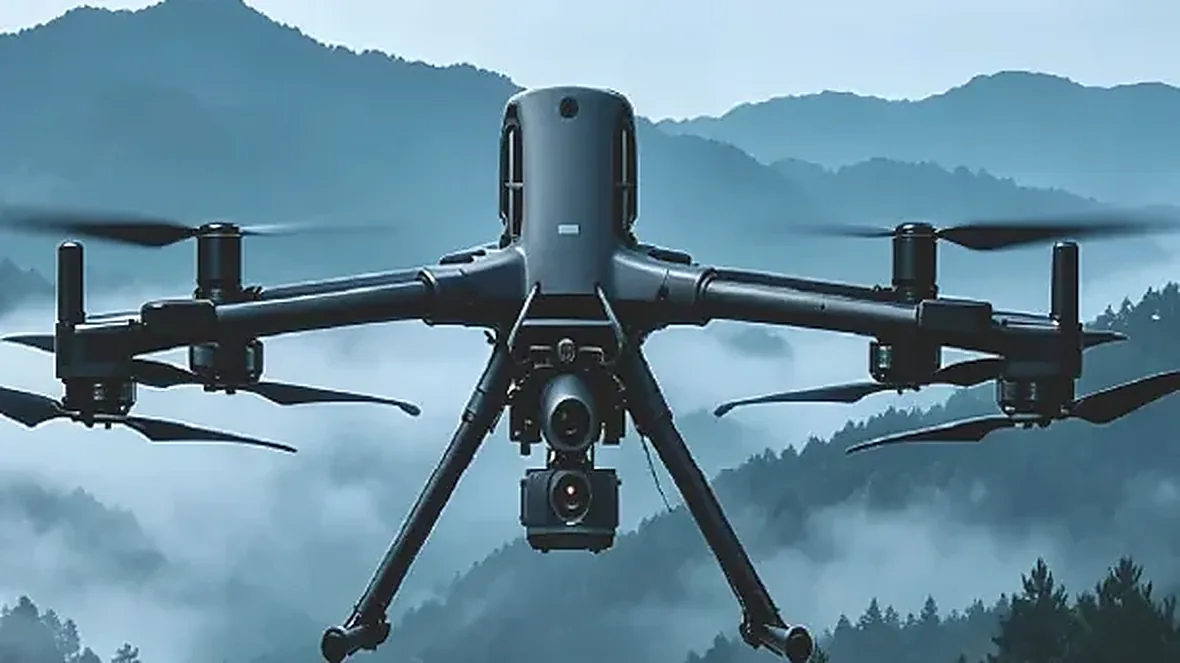
After years in this industry, the question we hear most often from Matrice 400 operators is: "how much can this aircraft really carry?" Our answer is usually another question: "are you after the number of payloads it can lift, or the ability to finish one specific job from start to finish?" Payload count only matters if it lets you finish in a single sortie. Doing two things in one flight beats being able to hang seven things in theory.
That is not a dodge. Six kilograms sounds like a lot until you add up the mount, the loudspeaker, the searchlight and the drop device, and start counting what is actually left over for the cargo. Look at it the other way and the picture changes: if one sortie can cover "see it, speak to it, drop to it," the landing and swap you skip in the middle can be the difference between arriving in time and arriving too late.
This article breaks down how the Matrice 400 actually gets used in the field: how each of five typical missions is configured, what the 15-degree center tilt is really solving, how to pair lighting with a loudspeaker, which three variables decide drop accuracy, why cargo work needs an exit plan before takeoff, how water sampling keeps the operator on the bank, and the four mistakes that most often derail a payload order.
Updated September 2026. Compiled from DJI's published specifications, measured product data and publicly available market research.
Key figures first (market size plus measured limits, so you can judge quickly whether this is worth reading):
- The global drone payload market was about USD 4.15 billion in 2025 and is projected to reach USD 6.69 billion by 2030 (CAGR 10.0%, MarketsandMarkets). The sub-25 kg payload class holds the largest share — the M400's 6 kg sits squarely in that mainstream band
- Matrice 400 published specifications: 6 kg maximum payload, four E-Port V2 connectors on the airframe, up to 7 payloads mounted simultaneously, 59 minutes forward flight time, IP55 rating
- The mounts themselves are light: single center gimbal bracket 80 g, dual center gimbal bracket 165.5 g, four-stage dropper 120 g, two-stage dropper 43 g — most of the 6 kg goes to whatever does the actual work
- The UAV water sampling system market was about USD 221 million in 2025 and is projected to reach USD 581 million by 2032 (CAGR 14.8%, PW Consulting). Multi-rotor platforms accounted for roughly 54.5% of 2025 shipments
- Measured numbers for the night pair: T90 combined searchlight delivers 13,000 lumens; H150A loudspeaker reaches 130 dB maximum sound pressure; the DU4 combined loudspeaker and light produces 3 lux center illuminance at 150 m over a 1,063 m2 area
- Two jobs on one takeoff: the dual center gimbal bracket runs two payload ports at once, so a dropper and a loudspeaker can fly together and you skip the return-to-swap leg
- A way out on cargo work: the PL10 cargo kit supports one-touch hook release and rope jettison from the remote controller or app, cutting the risk chain and saving the aircraft if the line snags
What the Matrice 400 Does: Five Core Missions
Start with the jobs, and the configuration discussion has somewhere to land.
1. Night search, rescue and lighting (putting the light source in the sky)
The hardest part of a night search is not the final find — it is not knowing where to start. Ground teams are limited by terrain and cover a few kilometres an hour at best. If the subject is off the search line, the previous hours count for nothing. What is missing at that point is not more people, it is a light source that can move. Mounting a searchlight replaces a 30-metre handheld beam on the ground with area coverage from several dozen metres up, and it moves. The T90 combined searchlight runs four LED groups at 13,000 lumens. When you need a tighter beam, the T90 V2 multi-colour zoom light gives you 9-degree and 16-degree steps — narrow for pinpointing, wide for sweeping — switchable within a single flight.
2. On-site loudspeaker work and cargo dropping (two jobs in one sortie)
Many situations need two things at once — people need to hear you, and something needs to get down to them. The conventional approach flies it as two sorties: loudspeaker first, land, swap to the dropper, fly again. What the dual center gimbal bracket gives you is that second sortie removed. Two payload ports run at the same time, so PTS4, PT4, PT2 and UT4 series droppers can fly alongside the DJI V1 loudspeaker. On a scene measured in minutes, one skipped swap can be the difference between arriving in time and arriving too late.
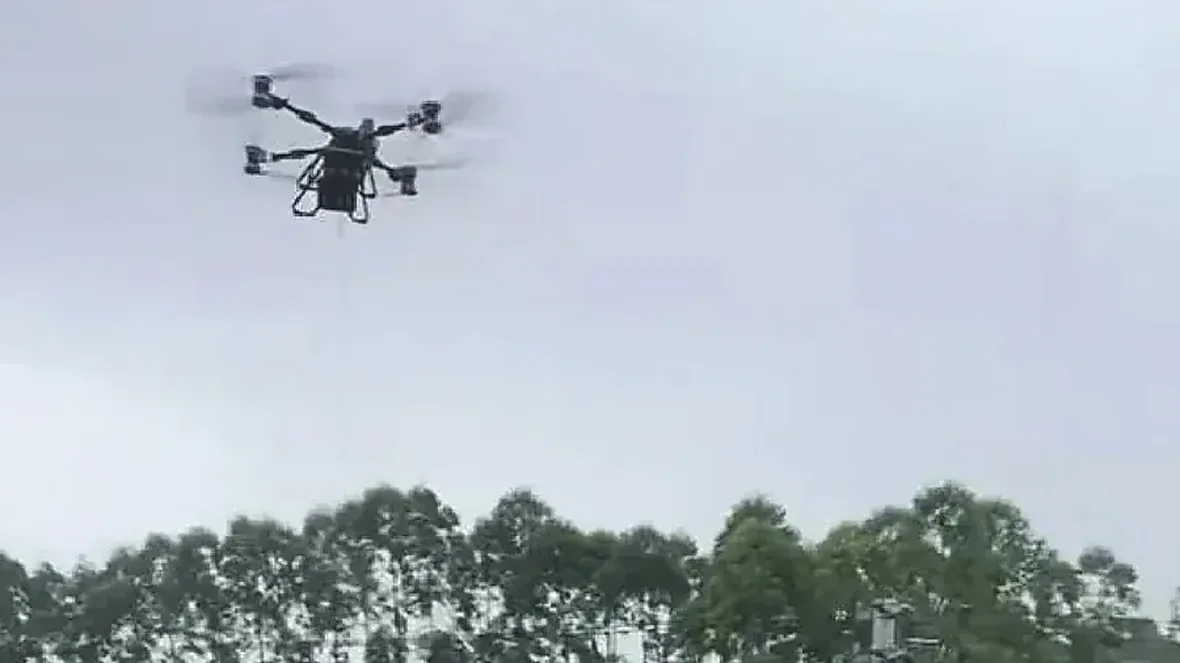
3. Supplying cut-off and disaster sites (so the ground team does not have to watch the sky)
Landing supplies on a point and making sure the receiver knows they arrived are two separate problems. The second one gets overlooked constantly: the drop succeeds, but nobody on the ground heard or saw it, and the package is sitting in tall grass. The UT4A four-stage audible-and-visual dropper stitches the two together. Four payload bays, a built-in high-output alarm and full-colour RGB LEDs — the moment it releases, the alarm sounds and the strobe fires. The ground team does not have to keep looking up; they hear where it landed.
4. Cargo lifting and line laying (the only job that needs an exit plan in advance)
The first three are about letting something go downward. Cargo work carries the load under the airframe for the whole flight, and that is a different risk class entirely. The rope can catch on a branch, a power line or anything on a cliff face, and at that moment the pilot has two options: fight it, or let go. The PL10 cargo kit gives you the safe version of the second option. Mountain line laying, river crossing pulls and construction-site lifting all run on it.
5. Water sampling (keeping the operator on the bank)
Water sampling sounds low-risk, and that is exactly why the risk gets underestimated. The traditional method is to row out to the point and take the sample by hand — at night, in high wind, or over a settling pond you would rather not be near, that step is itself the hazard. The FC100 Pro intelligent water sampling system keeps the person on the bank without giving anything up on safety, time or sampling accuracy.
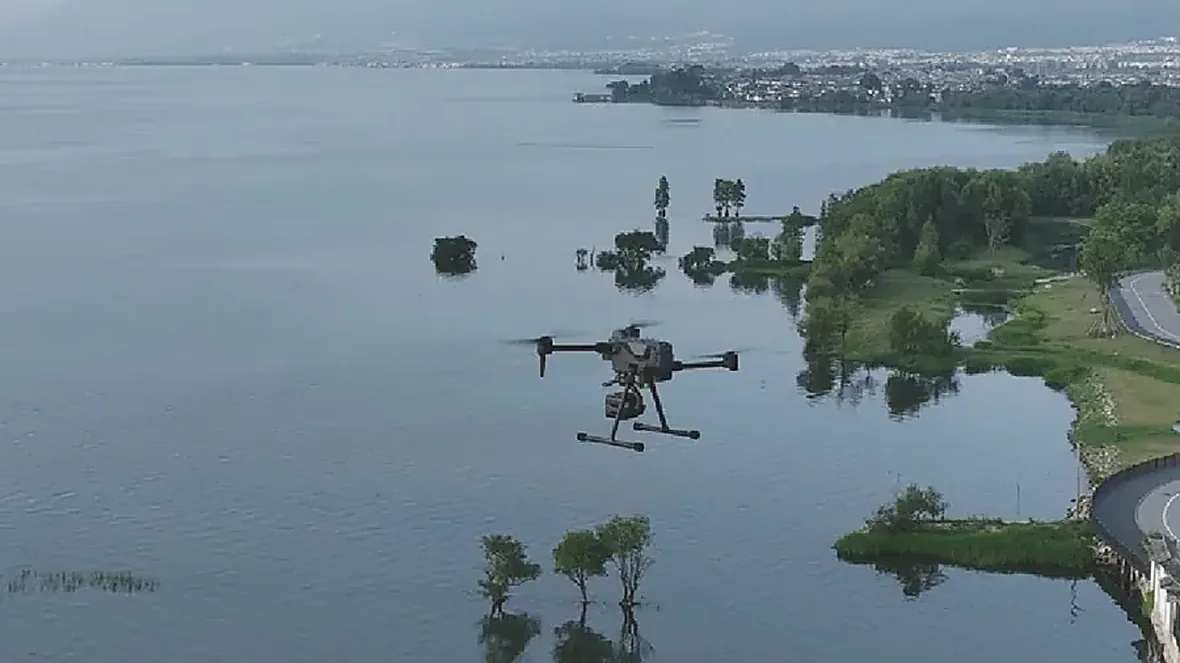
The Mounting Bracket: What the 15-Degree Center Tilt Is Actually For
Start with the ports and payload budget the M400 gives you
This generation of the Matrice 400 handles external power and communication over E-Port V2, with four connectors on the airframe. Published figures are 6 kg maximum payload and up to 7 payloads at once. Those four numbers determine every configuration decision that follows: 6 kg is the total, not the limit per port, and the 7-payload allowance has to fit inside that total. One more thing worth knowing — the M400's E-Port V2 is not the same interface as the E-Port and SkyPort V2 on the M300 RTK and M350 RTK generations, so an existing fleet's payloads do not simply transfer.
The 15-degree tilt is not a styling detail
On a heavy-lift airframe, the closer the load sits to the center of the body, the less work the flight controller has to do. Mount it off-center and nothing fails immediately, but you feel it: the hover drifts slightly, the stick returns to center more slowly, and wind resistance costs noticeably more battery. Both the single and dual center gimbal brackets use a 15-degree tilt to keep the mount point as close to the airframe's center of gravity axis as possible while holding the payload level. The check is simple: mount it, hover for thirty seconds, and see whether the aircraft needs constant stick input to hold position.
| Mounting bracket | Weight | Dimensions | What it carries |
|---|---|---|---|
| Single center gimbal bracket | 80 g | 90.9 × 205 × 31.6 mm | Drop payloads such as UT4A and ET4, plus other PSDK payloads; can be installed together with the DJI third gimbal bracket |
| Dual center gimbal bracket | 165.5 g | 92 × 131.5 × 27.5 mm | PTS4 / PT4 / PT2 / UT4 droppers plus the DJI V1 loudspeaker, both ports in use at once |
| PL10 cargo kit | Per shipped configuration | — | Designed specifically for the M400, direct belly mount, works with the aircraft's cargo mode; can be installed together with the DJI third gimbal bracket |
Lighting and Loudspeakers: The Two Critical Items for Night Work
Three numbers to look at on a searchlight
| Model | Key specification | What it actually lights |
|---|---|---|
| T30 V2 combined searchlight | 40 W, 14-degree spot, 117 g | 24 lux center illuminance at 50 m altitude |
| T60 combined searchlight | Two lens groups, uniform 16-degree beam | Reaches beyond 150 m; over 150 m2 covered at 50 m |
| T90 combined searchlight | Four LED groups, 13,000 lumens | Large-area search and sweep |
| T90 V2 multi-colour zoom light | RGBW five-lens, up to 150 W mixed white, 9°/16° zoom | Switch between pinpointing and sweeping in one flight |
Three practical details on loudspeakers
- Being understood beats being loud: in noisy environments speech clarity matters more than raw sound pressure. The H150A uses a four-in-one high-frequency driver to hold clarity while reaching 130 dB
- Hovering low works better than shouting from high: holding 20-30 m above the target beats addressing the wind from 70 or 80 m
- If you do not want to swap parts, use a combined unit: the DU4 folds loudspeaker, light and strobe into one unit, 14-degree spot, 3 lux center illuminance at 150 m covering 1,063 m2
Dropping and Delivery: Three Variables Decide Whether It Lands Where You Aimed
What you can drop, and which model does it
| Model | Bays | Characteristics |
|---|---|---|
| UT4A four-stage audible/visual dropper | 4 | Built-in high-output alarm plus full-colour RGB LEDs; audible and visual cue at the moment of release |
| PTS4 four-stage visual dropper | 4 | Integrates a full-function camera; the drop is visible and landing status can be sent back to the ground station |
| PT4 four-stage dropper | 4 | Only 120 g; four hooks in any order with automatic position recognition |
| AD2 two-stage dropper | 2 | All-alloy 43 g, E-Port Lite interface, uses almost none of the payload budget |
Three numbers to compensate for on the drop point
- Altitude: the higher you are, the harder accuracy gets; drift from the height difference compounds at each stage
- Wind speed: wind drift is the single biggest source of drop error; compensate the release point for both headwind and tailwind
- Descent method: lower fragile or precision items on a line; robust cargo can free-fall
Cargo Work: Why the Exit Plan Matters More Than the Payload Number
What the PL10 gives you is a controlled way out
The PL10 cargo kit is designed specifically for the DJI Matrice 400. It mounts directly to the belly, uses screw quick-release with E-Port V2 plug-and-play, and runs with the M400's own cargo mode, holding attitude control and load stability while carrying. The part that actually matters: when something snags or tangles, you can release the hook and jettison the rope with one action from the remote controller or the app. Trading one rope for one aircraft and one pilot is arithmetic anyone can do.
It also installs alongside the DJI third gimbal bracket — giving up an entire payload position just to run one lifting sortie is not a good trade.
Water Sampling: Four Things the FC100 Pro Does That Nothing Else Does
1. Non-invasive mounting, original obstacle avoidance fully retained
The structure is custom-shaped to the airframe and stays clear of the sensor positions, preserving 100% of DJI's native visual obstacle avoidance and safety systems. Why that carries weight: flying low over water is precisely the condition where obstacle avoidance matters most, and a lot of third-party payloads block the sensors once installed.
2. Four litres per cycle, with accurate depth targeting
It goes past the limits of conventional payloads with up to 4 litres per cycle, and a built-in high-precision depth algorithm holds depth error under 10%. That settles the old question of whether the sample actually came from the depth you wanted.
3. Manual and automatic together, with millisecond takeover
A dedicated visual app runs preset point, depth and repeat sampling tasks with one tap. If something interferes with the signal, it hands over to full manual control in milliseconds.
4. Any hour of the day
It supports night sampling and intelligent alerts, so sampling no longer has to fit inside a daylight window — and the people on the bank stay out of harm's way.
Lessons Learned: Four Mistakes That Most Often Derail an M400 Payload Order
Mistake 1: treating 6 kg as the limit per port
The published figure is the total. Fill all four ports and you still cap out at 6 kg, and the further the mount sits from the airframe center, the less usable margin you actually have.
The fix: add up the bracket weight first, then the payload, then the cargo. Make "hover for thirty seconds and see if it needs constant stick input" the acceptance test for every configuration.
Mistake 2: moving PSDK payloads straight over from the M350
The M400 uses E-Port V2, which is not the same as the E-Port and SkyPort V2 on the M300 RTK and M350 RTK generations. The interface changed, so either move to payloads built for it or confirm an adapter exists first. Stating the aircraft model and interface before you order is far cheaper than discovering the mismatch on arrival and losing a week.
The fix: send "aircraft model plus existing payload model" when you request a quote, and make the supplier confirm interface compatibility instead of assuming it carries over.
Mistake 3: taking off on the mission right after mounting
A payload changes the aircraft's center of gravity and aerodynamics. Launching straight into the job skips the acceptance check.
The fix: hover briefly after mounting — work the sticks in a few directions, listen for anything unusual, confirm the attitude returns to center properly. Two minutes, and it means finding the problem at three metres instead of at eighty.
Mistake 4: checking whether it is in the catalogue, not why it was designed that way
Two brackets can both mount in the center position, but tilt angle, dual ports and whether they coexist with the third gimbal bracket decide whether the combination actually solves your problem.
The fix: describe the job rather than quoting a part number. Knowing what you intend to do is what tells us which parts fit — and which money does not need spending.
In One Sentence
The logic behind an M400 build is "lift it high, say it clearly, get it there, and be able to back out" — the searchlight puts the light source in the sky, the loudspeaker gets the message across a noisy scene, the dropper gets supplies where no vehicle can reach, and the cargo kit leaves a one-touch release as the way out. Add water sampling and a 6 kg platform covers far more than inspection work. The global drone payload market was about USD 4.15 billion in 2025 growing at 10% a year, with the sub-25 kg class holding the largest share — the M400 sits right in that mainstream band. Before you configure anything, settle one question first: which jobs do you need this aircraft to do for you next year?
We Need Your Scenario
Whether you are an emergency response unit, a systems integrator in public safety, or a distributor looking to enter the drone industry, send us a description of your scenario and we will put together configuration advice and a budgetary quote at no cost.
- Emergency / rescue / public agencies (adding mission capability to an existing M400) → we put together a combined "bracket plus payload plus workflow" recommendation covering loudspeaker, lighting, dropping, lifting and sampling
- Distributors / integrators (bidding on projects) → we provide product selection, solution support and tender documentation; the procurement process in our government drone procurement guide is a useful reference
- Running an M350 / M30 / FC30 or third-party aircraft → brackets have to be matched to the specific model, so send us the model and we will configure against it; the underlying logic of payload combination is the same one set out in our firefighting drone operations guide
How to reach us: leave a message on the inquiry page marked "M400 mission configuration" and we reply within 24 hours. Selection advice is free. You can also ask about parts that are not in our catalogue — sourcing outside the catalogue is part of what we do.
FAQ: Frequently Asked Questions
Do you sell the Matrice 400 aircraft itself?
No. The Matrice 400 is a DJI aircraft, and we are neither an authorised dealer nor an airframe reseller. What we supply is the bracket, loudspeaker, searchlight, dropper, cargo kit and sampling system, plus the advice on combining them on an M400.
Are these brackets original DJI parts?
No. We are a third-party manufacturer of compatible parts. The products are built to work deeply within the DJI ecosystem — plug-and-play, operating over the flight control protocol, controlled directly from DJI Pilot 2 or the corresponding app. Being a third party is also what lets us combine loads from different brands and different functions onto one M400.
Can PSDK payloads from the M350 RTK keep working on the M400?
Not directly. This generation uses the E-Port V2 interface, which differs from the E-Port and SkyPort V2 on the M300 RTK and M350 RTK. Existing payloads either need to move to the current generation or you need to confirm an adapter exists first. Brackets in particular must be matched to the airframe: the M350 RTK uses its own dedicated PSDK quick-release bracket, which is an entirely different part from the M400's center gimbal bracket.
Is 6 kg of payload enough?
It depends on the job. The brackets themselves are light — 80 g for the single gimbal bracket, 165.5 g for the dual — so the budget goes to the payload and the cargo. Loudspeaker and searchlight work sits comfortably in the few-hundred-gram to two-kilogram range. Lifting and high-volume delivery depend on the load mode rather than raw weight. Describe the form of the cargo and how much you need per sortie, and it becomes answerable.
Can you source parts that are not in the catalogue?
You can ask. Requirements in this industry move faster than any shelf: inspection equipment with an unusual interface, replacements for discontinued models, mounting solutions built for one specific trade. When that happens we go looking on the supply side, and come back with price and lead time once we find something that works. It is not a guarantee, but it is usually much faster than searching on your own.
How do we start?
The most useful opening is a description of the job rather than a list of parts: the scenario, what you are working against, how many things one sortie has to accomplish, and what aircraft you run now. With that we can tell you what fits and what you do not need to spend on. Leave a message on the inquiry page — selection advice is free.
Disclaimer: this article is compiled from DJI's published specifications, measured product data and publicly available market research. Specific parameters are subject to the supplier's latest information and the actual aircraft. Always operate in accordance with local drone regulations.