In the years I have spent exporting, the site photos customers send have something in common: a transmission tower on a hilltop, or a substation out in the desert, with the nearest neighbour ten kilometres away, never mind mains power and a network cable.
And the question is almost always the same: "Can the drone just live there, fly itself when it is time, and come back to charge?"
Translated into procurement language, that is an automatic charging dock. The industry calls it drone-in-a-box; some call it a drone nest or a drone airport.
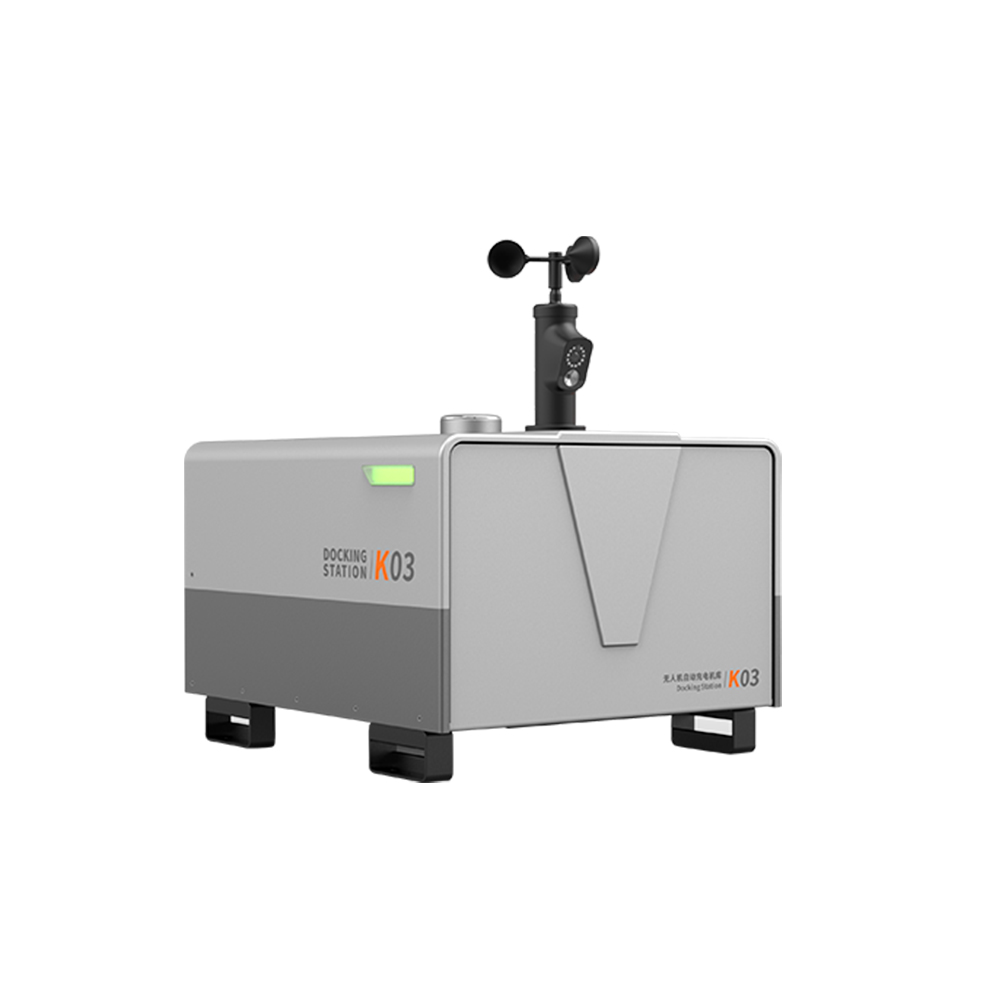
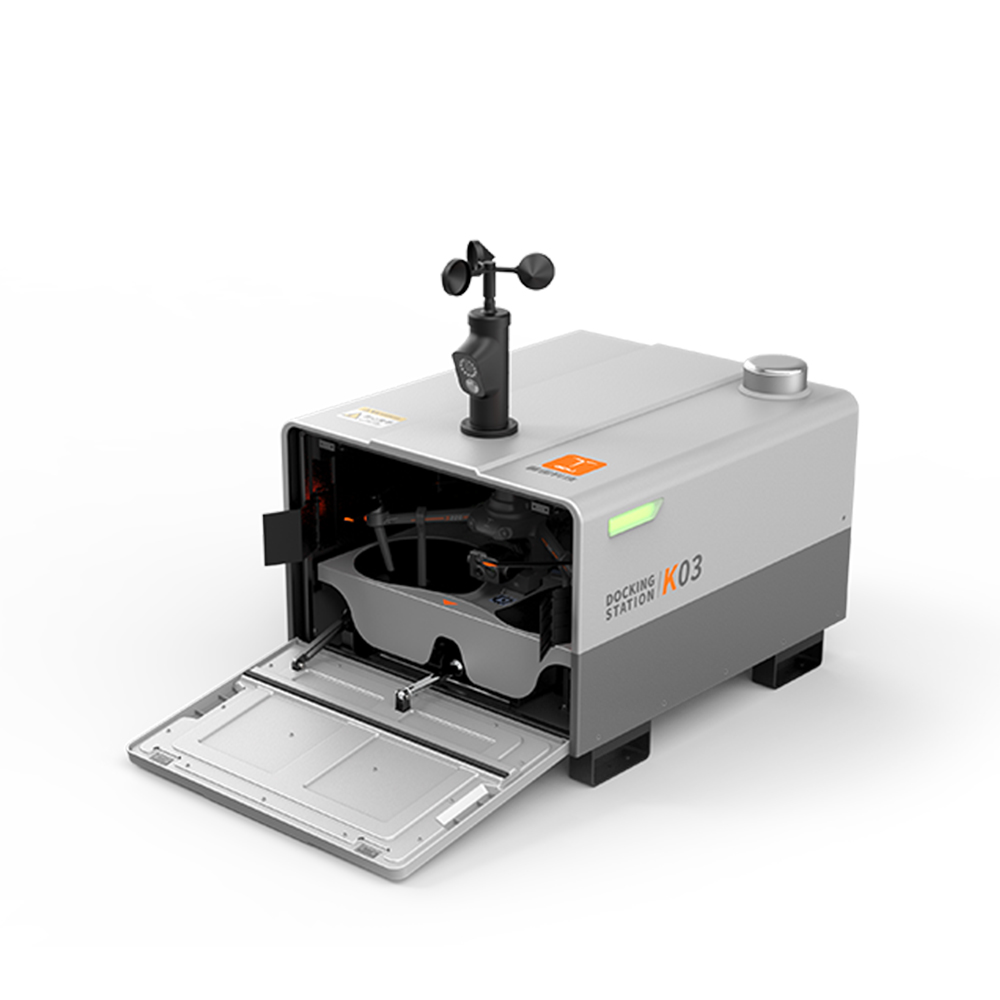
That is exactly what the K03 automatic charging dock does: the aircraft lives inside the box, rolls out automatically when a task is due, flies the mission, returns to charge, and pushes the imagery back on its own. But whether it is worth buying depends on what your site looks like. So this article tries to cover the whole picture: what this form factor has actually delivered in real projects, what the K03 specifications mean, how the money works out, and the cases where I would tell a customer to hold off.
Verdict first: a dock is a capacity tool for customers with fixed sites and high mission frequency. It is not an upgrade part for every drone user.
1. This has already been proven in the field. Start with the numbers.
This is past the proof-of-concept stage. I have pulled together publicly verifiable deployments, sorted by scenario, so you can take them straight to your boss:
| Scenario | Who runs it | Public result | Source |
|---|---|---|---|
| Transmission line inspection (city grid) | Shenzhen Power Supply Bureau, China Southern Power Grid | 101 drone docks at 89 sites across the city, covering over 3,600 km of transmission lines; crews never leave the office, manual control time cut by nearly 80%, inspection efficiency up nearly 4× | Xinhua, China Economic Net, Dec 2024 |
| Distribution network inspection | Taizhou Power Supply Company, State Grid Zhejiang | 4 grid-point docks covering 25 lines and 147 km of 10 kV network; a 20 km line used to take several people a full day, now it is one takeoff button | People's Daily Zhejiang, Nov 2021 |
| Compact substation dock | State Grid Fujian (Sanming, Fuzhou) | Dock under 1 m long and wide, about 120 kg, more than RMB 50,000 cheaper than a conventional dock; one dock covers a 3 km grid | China Economic Net, Apr 2021 |
| Large solar plant | EnBW, Germany (PV capacity grew from 150 MW to 1 GW in four years) | Removed a 6-hour round trip to site; inspection frequency moved from once a year to once a quarter | EnBW technical lead, published FlytBase case study |
| Industrial city in the desert | Sudair Industrial City, Saudi Arabia (16.9 km², 420+ factories) | Around-the-clock unattended patrols; aircraft charge from 20% to 90% in about 25 minutes after landing | Terra Drone Arabia published solution (citing third-party reports such as Fortune Business Insights) |
| First response | Fairfax County Police Department, Virginia, USA | First 100 missions: average 83 seconds on scene, 71 of them arriving before other response units | County police department public data |
| First response at scale | Montgomery County, Maryland, USA | More than 2,000 flights since launch, average under 90 seconds on scene; 151 of the first 1,000 flights removed a patrol car dispatch | County government public notice |
| Fully off-grid mine | MTGA and Advanced Avionics, Australia | Solar and satellite-linked dock trailer running a "charge 30 minutes, fly 30 minutes" cycle with nobody on site | Manufacturer published material |
One clarification before we go on: all of the above are public industry cases, quoted to judge whether the dock form factor works at all. The K03 is the companion dock for the S220 PRO and has no compatibility relationship with any other dock system in that table.
Put the eight cases side by side and the pattern is plain: the sites are fixed, the missions are frequent, and none of them is convenient to staff all year round. Remove any one of those three and the economics get worse. That is where the "who should not buy" section later comes from.
2. What the K03 is: a dock one person can lift
The K03 is the automatic charging dock built for the S220 PRO recon aircraft. Three numbers first. They are the easiest to overlook and the most useful in a sales conversation.
- Closed dimensions 650 × 555 × 370 mm, roughly the footprint of a small office desk pedestal
- Unit weight ≤50 kg
- Footprint about 0.36 ㎡
What does 50 kg mean? Compare it with common equipment in the industry: the "compact" dock State Grid Fujian built weighs 120 kg; the published weight of DJI's first-generation Dock is 150 kg (that figure appears in the EnBW FlytBase case). In other words, the K03 weighs about one third of comparable equipment.
That third is very concrete on site: it fits in a pickup, two people can carry it onto a roof, and it can sit beside a substation building or a guard post. No crane, no separate load-bearing reinforcement just for the dock. A lot of projects stall at exactly this step.
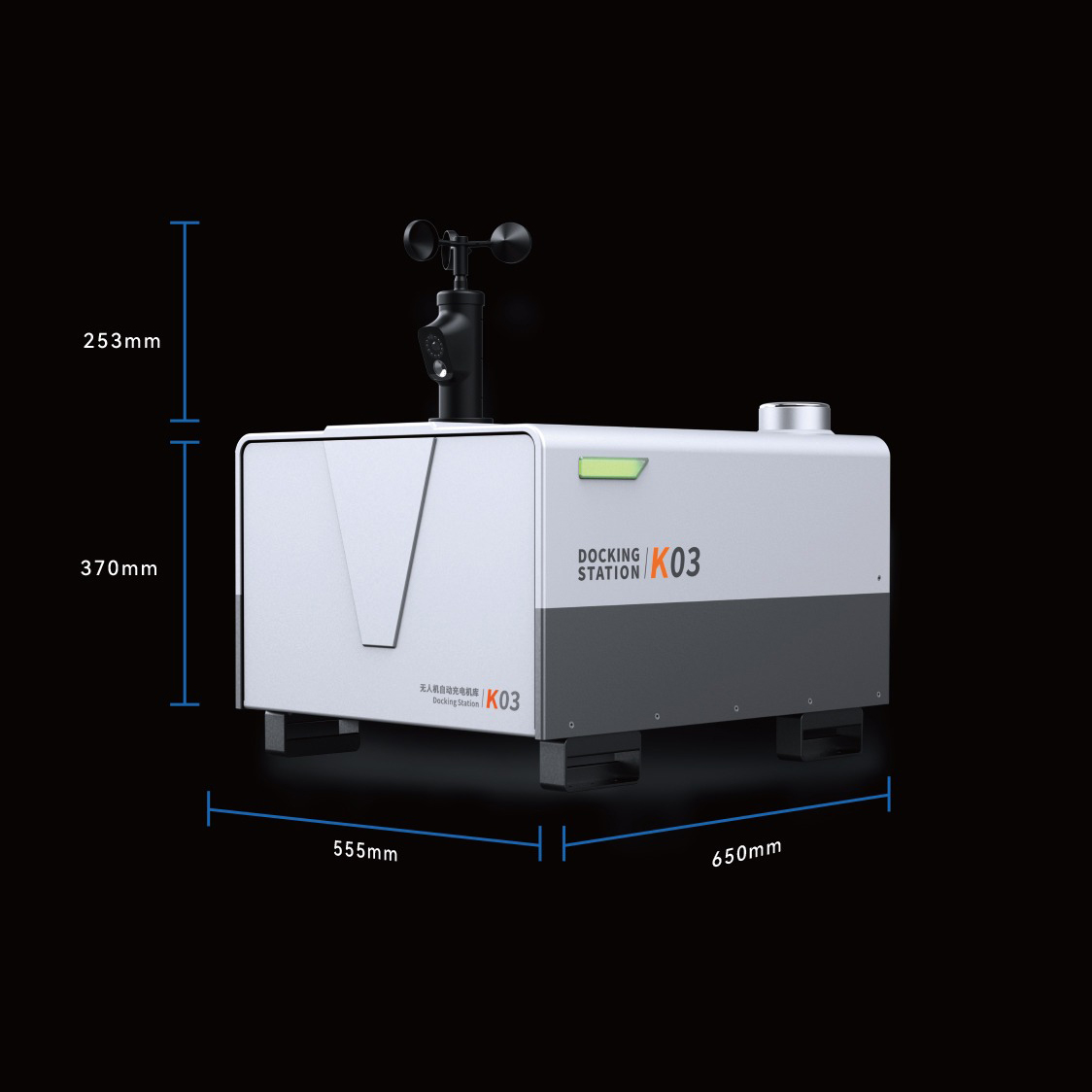
Hardware specifications, all on the table as usual (as configured on the product page):
| Specification | Value | What it means |
|---|---|---|
| Aircraft | S220 PRO | Designed as a pair, not a generic open platform |
| Closed / open dimensions | 650 × 555 × 370 mm / 1380 × 555 × 370 mm | Carryable by one person; opens into a full landing platform |
| Unit weight | ≤50 kg | Pickup transport, two-person handling |
| Footprint | About 0.36 ㎡ | Roof, substation building, guard post |
| Standby power | <10 W | About the same as a home router |
| Peak power | ≤1000 W | Ordinary socket load, no site rewiring |
| Charging | 10%→90% in ≤35 minutes | Supports high mission frequency |
| Backup battery | ≥5 h | Keeps standby alive through an outage |
| Power input | Mains / solar | Runs long term with no mains supply on site |
| Thermal control | -20~50 °C, TEC plates | Margin for desert afternoons and winter mine sites |
| Operating altitude | ≤5000 m | No special customisation for plateau sites |
| Wind | 12 m/s inspection / 8 m/s precision landing | Two separate ratings, not interchangeable |
| Operating radius | 8000 m | Normal coverage from dock to work area |
| Aircraft to dock data rate | ≤200 Mbps | Fast imagery sync after landing |
| Connectivity | 4G / MESH | Data gets out without broadband |
| Edge computing | Optional | Some recognition runs locally |
| RTK base station | Supported | Guides precision landing, usable at night |
| Leapfrog inspection | Supported | Multi-site relay for long routes |
The small wind vane on top is not decoration; it is an integrated weather station. Before takeoff the dock checks the sky itself: if wind exceeds the limit it suspends the mission automatically instead of sending the aircraft out to fight it.
3. The relationship with the S220 PRO: one system, do not sell it in parts
Let us be clear about positioning: the K03 is not a universal dock. It is the charging dock built for the S220 PRO. Dock and aircraft are designed as a pair across the landing mechanism, charging protocol and communication link.
When you put a proposal together, quote the two as one set. Do not promise "any aircraft will fit" just to close a deal; the cost of reworking that later is far higher than quoting one extra piece of equipment.
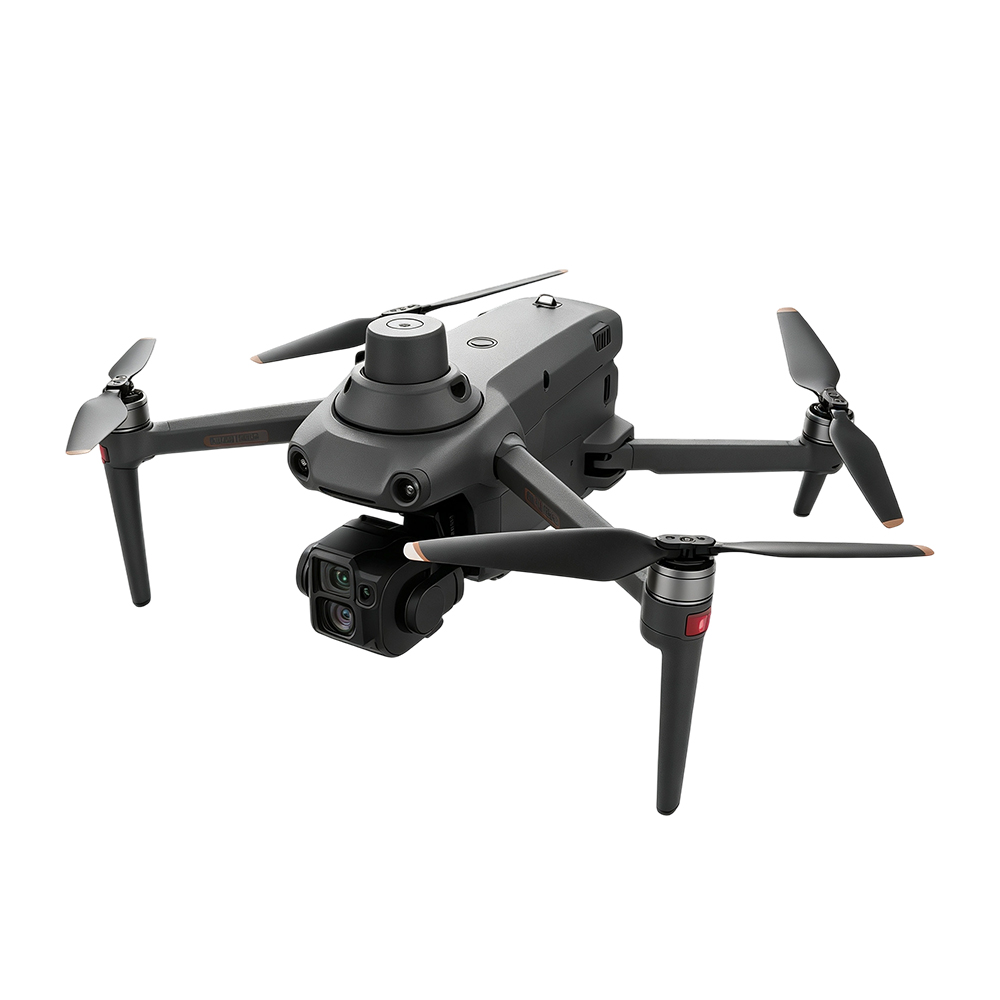
The division of labour is simple: the S220 PRO flies (recon, recognition, day and night imaging), the K03 runs the house (charging, standby, shelter, weather sensing, data relay). The aircraft's own capabilities are not the subject here; see the S220 PRO AI reconnaissance drone selection guide.
For dealers, the value of this combination in a sales conversation is practical: the customer's purchase moves from "buy a few aircraft" to "buy an unattended system", so deal size goes up. At the same time site staff do not need to know how to fly, only how to read results on the platform, which actually lowers training cost.
4. Off-grid power: the most valuable part of the K03
Why? Because the sites customers struggle with most are exactly the sites with no power. Under a transmission tower, at an oil and gas station in the desert, at a reservoir dam, at a border checkpoint. Running a power line to those places sometimes costs more than the equipment itself.
The K03 power design has three layers. Let me put numbers on each.
Layer one, standby power below 10 W. The figure looks unremarkable, but the dock spends most of its life asleep, holding only communication and temperature monitoring. Router-level consumption means under 0.24 kWh a day, under 8 kWh a month. That is the precondition for the whole system to survive on solar.
Layer two, solar supply. Add PV panels and the dock runs long term on sites with no mains. Most of the Middle East and Africa happens to have some of the best solar conditions in the world, so the same selling point is amplified rather than discounted in those two markets.
Layer three, backup battery for 5 hours or more. Through consecutive overcast days or a mains outage, the internal battery holds standby and emergency missions.
Peak power of ≤1000 W matters just as much. It means that where mains exists, an ordinary socket-level load is enough, and the customer does not have to rework site power for the dock. That line item is often left out of project budgets, but it is real money.
Off-grid docks are not only our conclusion. A manufacturer in Australia mounts the dock on a trailer with solar, batteries and satellite internet, running a continuous "charge 30 minutes, fly 30 minutes" cycle at off-grid mine sites in the Pilbara. The thinking is the same: solve the power problem on your own first, and only then can a dock really be unattended.
5. Fast charging and "leapfrog" operations: how one dock does the work of a fleet
Charging speed directly sets inspection frequency. The K03 brings the S220 PRO from 10% to 90% in under 35 minutes. By the time the aircraft is back in the nest, the power is back too.
The Taizhou case helps explain the rhythm: the drone flies 35 minutes to the battery limit, returns to the nest, swaps power in 3 minutes, goes out again, and repeats until the whole route is inspected. The value of a dock is not in a single flight; it is in repeating that cycle many times a day.
Single-site frequency is the baseline. The more interesting part is leapfrog operation. Along a route tens of kilometres long (a transmission corridor, a pipeline, a river), place a "dock + aircraft" station every so often: each aircraft flies its own segment, returns to charge, and the next one takes over, like a relay race where the runners change but the vehicle does not.
That placement logic matches the Shenzhen case: one nest there covers 26 circuits and more than 300 towers within a 5 km radius. The K03's normal operating radius is 8,000 m, which is a reasonable starting point for spacing.
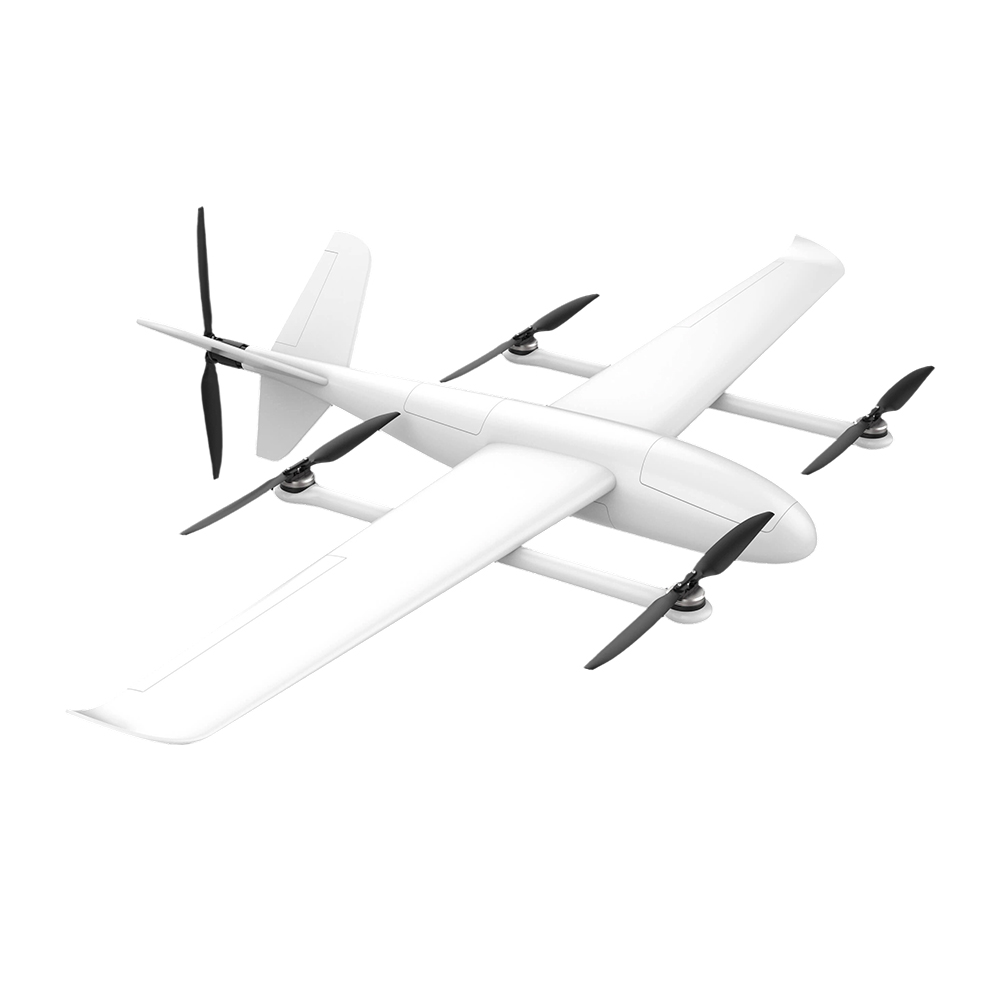
One warning: multi-site relay solves coverage length, not single-aircraft endurance. If the customer's requirement is "one aircraft flying tens of kilometres in one go", what they need is a long-endurance VTOL fixed-wing type; see the FY-VT04 long-endurance VTOL guide. Do not use a dock to answer an endurance question.
When you run the numbers with a customer, the logic is easy to explain: an inspector has an upper limit on how many towers they can see in a day, while a dock station can keep flying to a fixed rhythm as long as the weather allows. Labour costs rise every year; equipment cost amortises once.
6. Landing accuracy and weather tolerance: two pass lines for outdoor equipment
A dock sits outdoors on standby all year. If two things do not hold up, nothing else matters: how accurately it lands, and how well it takes the weather.
On landing, the K03 supports an RTK base station for high-precision positioning guidance, and the S220 PRO can land precisely into the nest at night, which is what makes pre-dawn inspections and sudden night checks work. Wind ratings come in two tiers: 12 m/s for inspection flight (around Beaufort 6), 8 m/s for precision landing control. Above the tier, the weather station stops the mission on its own.
On environment, -20 to 50 °C TEC thermal control covers a 50 °C desert afternoon and a severe winter at a mine site; maximum operating altitude is 5,000 m, so plateau sites need no special customisation. Internal temperature is managed automatically: pre-cooling in summer, pre-heating in winter, so the battery is at a suitable working temperature when the aircraft rolls out.
There is a public deployment in Jilin, China: winter there lasts half the year and temperatures drop to -20 °C, and the operations centre runs the dock remotely from 60 km away, precisely so line crews do not have to go out in that cold (source: public DJI and FlytBase case material). Sending a battery straight out to work in extreme temperatures is the hidden trap that kills many solutions which looked workable on paper. Temperature is not the place to save money.
7. Data backhaul: swapping people on site for people at the desk
The last link in unattended operation is data. The K03 and the S220 PRO inside it talk over up to 200 Mbps, so mission imagery syncs into the dock quickly after landing and the dock relays it to the back office.
Two ways to get online: 4G cellular, or a MESH self-organising network onto the nearest node. Remote sites without broadband can still get data out. Where budget allows, an edge computing module is optional, running part of the recognition locally and sending back only results, which saves bandwidth and cuts latency.
What this really changes is where people stand. The duty operator's job shifts from "carry the aircraft to site, come back and offload cards" to "watch alerts on the platform, review imagery, dispatch response".
The numbers from Montgomery County, USA show how big the manpower leverage is: in the first 1,000 flights of their drone first-responder programme, 151 flights removed a patrol car dispatch, the equivalent of freeing roughly 305 officers for other calls. Note that what falls is the number of dispatches, not the number of people; someone still has to watch the platform. That expectation has to be set before the sale, not after.
8. Where it fits: four scenarios that match best
Sort the cases above by industry and four customer types line up with the dock model:
1. Power inspection at the tower. Towers, substations, transmission corridors: fixed sites, high frequency, the classic use of leapfrog relay. Shenzhen, Taizhou and Sanming in Fujian all run this scenario, and it is also the industry with the densest public cases.
2. Campus and industrial park security. Industrial parks, ports, large plants: fixed-point watch plus scheduled patrol plus alert response, forming a layered perimeter with ground cameras. The Sudair Industrial City solution follows this logic: routine automated patrols to catch illegal dumping and unauthorised building, switching to "first responder" mode on an alarm and pushing live imagery to the command centre within minutes. AI tracking gimbals are a common pairing here.
3. Emergency response and event security. Standby in normal times, rapid dispatch when something happens. Fairfax County publicly reports 83 seconds average to scene, Montgomery County under 90 seconds. The value of that speed is not in what happens after arrival, but in the commander knowing what the scene looks like ahead of time. For temporary event security, vehicle-mounted plus dock gives you mobile deployment.
4. Energy and remote sites. Oil and gas stations, reservoirs, mine sites: far away, hard to staff permanently, and often with good solar conditions. Off-grid power is worth the most to these customers; the Australian trailer-mounted dock serves exactly this kind of site.
A simple test: Is the site fixed? Is the frequency high enough? Is it inconvenient to keep people there all year round? If the answer is yes to all three, the dock model is probably right.
9. How the money works: the public numbers, laid out
Every customer asks about ROI eventually. A few public figures are worth referencing directly:
- Solar plant (100 MW scale): DJI published a scenario calculation. With no inspection at all, lost generation can reach USD 140,000 a year. With manual inspection (two people need 5 hours per MW, 65 days for the whole plant), two inspections a year cost about USD 120,000. Moving to a dock solution, hardware plus software is about USD 45,000, and you can inspect 12 times a year or more. These figures appear in public articles by DJI partners such as heliguy and DroneDubai.
- Environmental patrol at a desert industrial city: calculations cited publicly for the Sudair project in Saudi Arabia put the total coverage cost of unattended patrol at about SAR 1.63 million, against SAR 4.73 million for truck patrols over the same area; after automated recognition and fast response, illegal dumping sites dropped by 96%.
- Security manpower: the same public material notes that replacing conventional guard patrols with an automated dock can cut security operating costs by 60 to 70%.
These are industry references, not numbers to plug straight in. Payback on any project depends on three things: how many sites, how often you inspect, and the local labour rate. Applying an industry average to your own project will always produce the wrong answer, which is why we ask for those three numbers first when building a proposal.
The market direction itself is clear: for the drone-in-a-box category, The Business Research Company puts 2025 at about USD 1.78 billion and 2030 at about USD 4.39 billion, a 19.7% CAGR; Fortune Business Insights puts 2025 at about SAR 5.5 billion and 2034 at about SAR 27.8 billion, a 20.07% CAGR. The two research houses differ on the absolute numbers but both point to growth around 20% a year. The Middle East and Africa is a pool of roughly USD 115 million, not large in share, with the incremental demand concentrated in power and security.
10. The honest account: who should buy, and who should not
A product article has to say both. In the following situations I would tell a customer to wait:
- The site moves. Here today, there tomorrow. A dock's value is in standing guard. For work that moves daily, a handheld aircraft plus a vehicle kit is better value.
- You fly a few times a year. A dock is a capacity tool; if frequency stays low, the cost never amortises. If the payback calculation comes out at five or six years, that site probably should not have one.
- You expect "fully unmanned". A dock replaces people on site, not people at the desk. Someone still watches the platform, handles alerts, and maintains the equipment (cleaning, checks, firmware). Anyone who promises "install it and forget it" has either never run a project or has no intention of doing support.
- Regulation is not sorted yet. Approval for beyond-visual-line-of-sight (BVLOS) and unattended flight differs widely by country. Markets such as the UAE require a licensed operator (see the UAE drone regulations guide), and before policy is settled it is best to verify case by case.
One more honest point: dock plus aircraft is one system, and training, platform, spares and maintenance all have to keep up. Our approach bundles selection, deployment, training and after-sales into the proposal, so the customer is not buying a box.
FAQ (drone dock)
Which drones does the K03 dock support?
The K03 is the companion automatic charging dock for the S220 PRO reconnaissance aircraft. The two are designed as a pair across landing, charging and communication, and should be bought as a set. We do not promise compatibility with other aircraft. If a customer wants to use a different aircraft, that needs a separate evaluation, and we make no upstream compatibility commitment.
Can it run where there is no mains power?
Yes. Standby power is under 10 W, so with solar panels it runs long term on sites with no grid supply, and the internal backup battery supports 5 hours or more. Where mains is available, peak power stays at or below 1,000 W, an ordinary socket-level load, so no power rework is needed.
How long does a charge take? Can it work continuously?
10% to 90% in under 35 minutes. A single site can inspect all day at a fixed rhythm. For long routes, multi-site leapfrog relay means each station's aircraft covers one segment, so full coverage does not depend on squeezing endurance out of one aircraft.
Can a dock replace people on site entirely?
It replaces people on site, not all people. The public Montgomery County numbers are a good reference: what drone first response saves is patrol car dispatches, not jobs. Someone still watches the platform, handles alerts and maintains the equipment. The right expectation is that one person moves from watching one site to watching several.
What approvals are needed to deploy a dock?
Countries differ on approvals for beyond-visual-line-of-sight (BVLOS) and unattended flight, and most markets require a licensed commercial operator with per-project approval. According to public material from the drone automation platform FlytBase, its customers have obtained BVLOS operating approvals from the FAA (United States), EASA (European Union), JCAB (Japan), CAAM (Malaysia) and GCAA (UAE), which shows the path exists. Conditions vary a lot between countries, though, and it is worth verifying case by case before a project starts.
What happens in extreme weather?
A weather station is integrated into the dock roof, monitoring wind speed and direction in real time and suspending missions automatically when limits are exceeded. Inspection wind rating is 12 m/s, precision landing 8 m/s; -20 to 50 °C TEC thermal control keeps the battery at a suitable temperature; maximum operating altitude is 5,000 m. Our position on weather is to sense it and decide automatically, not to tough it out.
Wrapping up
Put the Chinese grid, German solar, Saudi industrial city and US police cases side by side and the case for dock-based operations is fairly solid: the market is growing at double digits, the public ROI arithmetic works, and power and security demand in the Middle East and Africa happens to fit.
But it is a system, not a box. Look at aircraft, dock, platform and compliance together when you select, or you will buy something that just sits there. Still unsure whether a dock fits your sites? Work through the nine questions in this drone dock buyer's checklist first — the answer usually falls out on its own.
If you have a real project in hand, send us three things: how many sites, how often you inspect, and what power is available on site. We will put together a deployment proposal and payback estimate around the actual K03 + S220 PRO configuration. If you need a configuration that is not in the catalogue, ask anyway; we know where to find it.
Product specifications follow the actual configuration on the product page. Cases and market data in this article are cited from public sources (Xinhua, People's Daily, China Economic Net, FlytBase, Terra Drone Arabia, public data from Fairfax County and Montgomery County, published DJI partner calculations, The Business Research Company, Fortune Business Insights and others). Third-party estimates are directional only; please model your own project on its actual conditions, and verify regulations and project details case by case before deployment.