Drone Thermal Camera Resolution: Why Two 640×512 Gimbals See 2.5x Apart at Night
Put three gimbals side by side. All three use a 640×512 infrared detector, identical pixel counts. Their night recognition range against an adult target is rated >120 m on one, >220 m on the second and >300 m on the third. That is a 2.5x gap between two products carrying the same four digits on the spec sheet.
Most buyers order on the strength of "640×512" alone, then find out on the first night mission that at the distance where the target should be recognizable, the picture holds nothing but a smudge nobody can call a person or a tree. This article works out where that gap comes from: which parameter actually drives it, whether you can back-calculate it yourself, and why going from 384×288 to 640×512 sometimes buys you nothing at all.
Specifications in this article are taken from the factory data sheets of our products in the current range. The angular resolution and recognition range figures derived below are worked examples based on geometry, not measured results; actual performance must be confirmed against your platform and operating conditions.
Pixels Decide How Fine the Picture Is; Focal Length Decides How Far That Detail Reaches
640×512 is a detector specification — an uncooled LWIR sensor responding in the long-wave infrared band — and it has nothing to do with the lens. Bolt the same 640×512 detector behind different focal lengths and you get two completely different pictures: the longer the focal length, the narrower the field of view, and the same number of pixels spread across a smaller patch of ground, so each pixel is allocated a smaller share of that ground.
Written as a formula, angular resolution per pixel equals field of view divided by pixel count. Run the division across three 640×512 gimbals in our range and the gap appears immediately:
| Model | IR Focal Length | IR Field of View | Angular Resolution per Pixel | Day Recognition | Night Recognition |
|---|---|---|---|---|---|
| PUTD070A | 9.1mm | 48.3°×38.6° | 0.0755° | >350m | >120m |
| PUTT155 | 18mm | 24.4°×19.5° | 0.0381° | >400m | >220m |
| PUTT170 | 25mm | 17.5°×14.0° | 0.0273° | >400m | >300m |
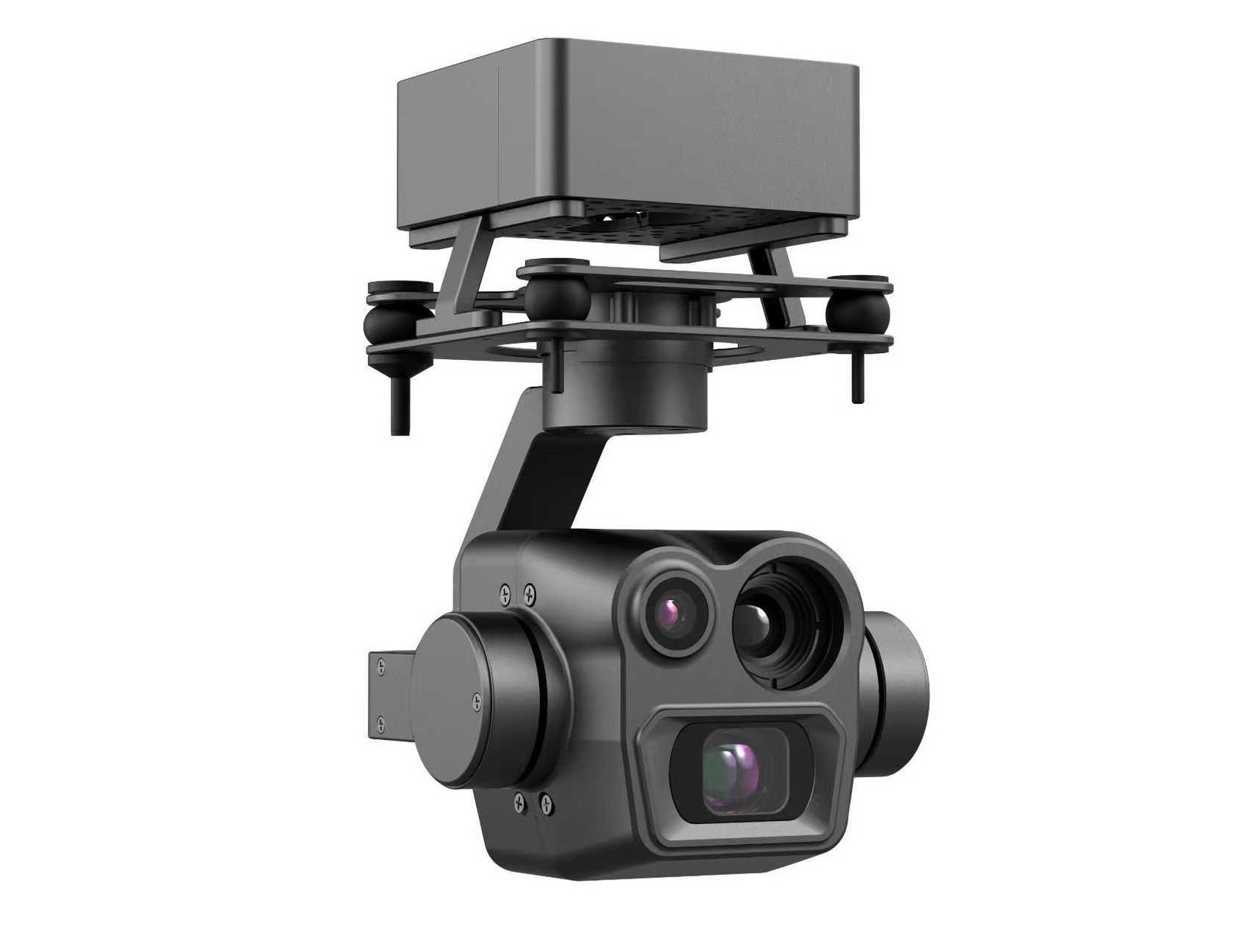
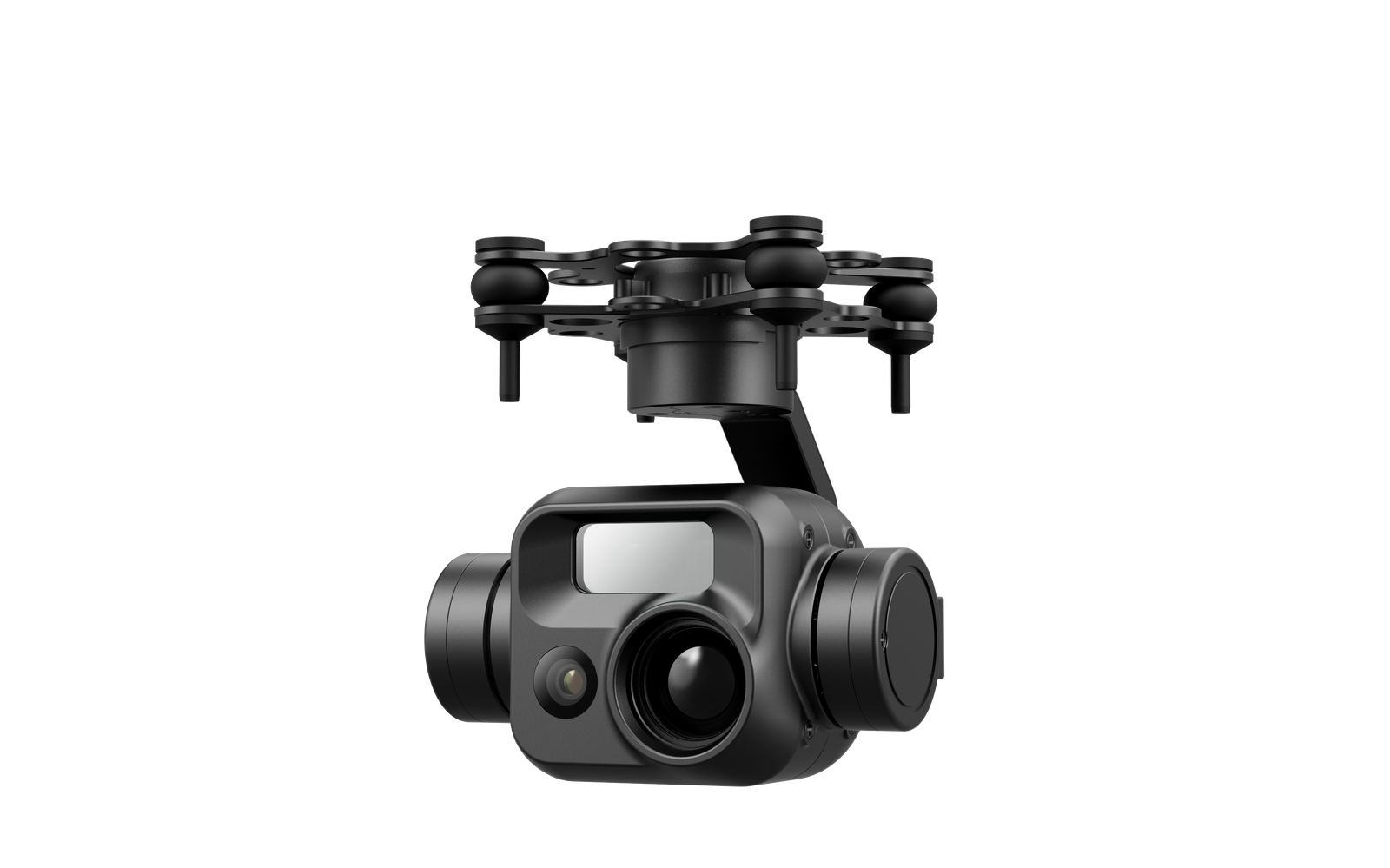
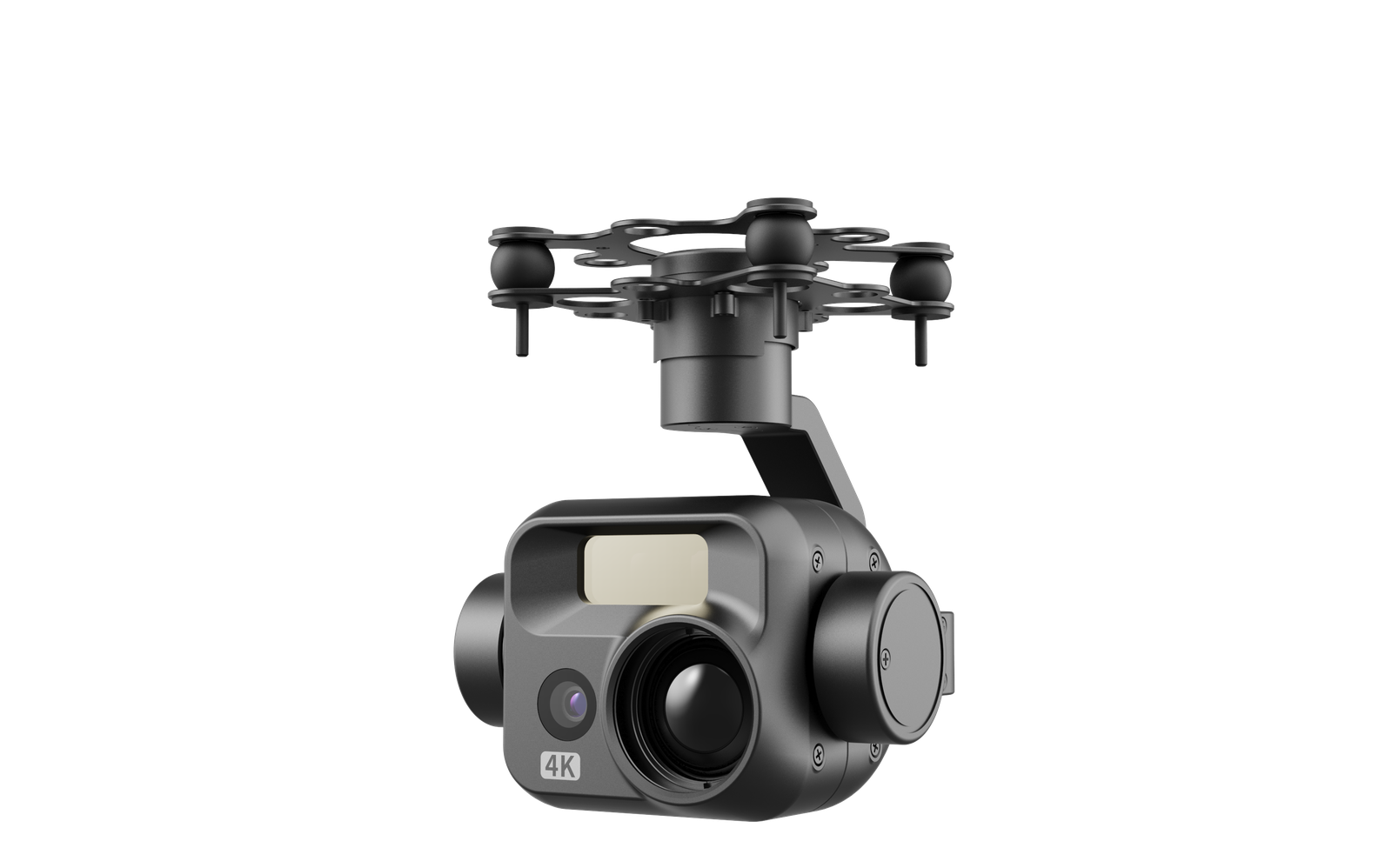
The PUTD070A in the picture is the first row — a 640×512 thermal channel paired with a 9.1mm short-focal infrared lens, 48.3°×38.6° field of view, the small lens on the left carrying the visible channel and the large one in the middle the infrared. Its detector is uncooled LWIR responding from 8 to 14 μm; the PUTT155 and PUTT170 work from 8 to 12 μm, a difference in window transmission that does not change the logic of this selection line. Its day recognition reaches 350 m and its night recognition drops to 120 m, and that step down is what this article takes apart.
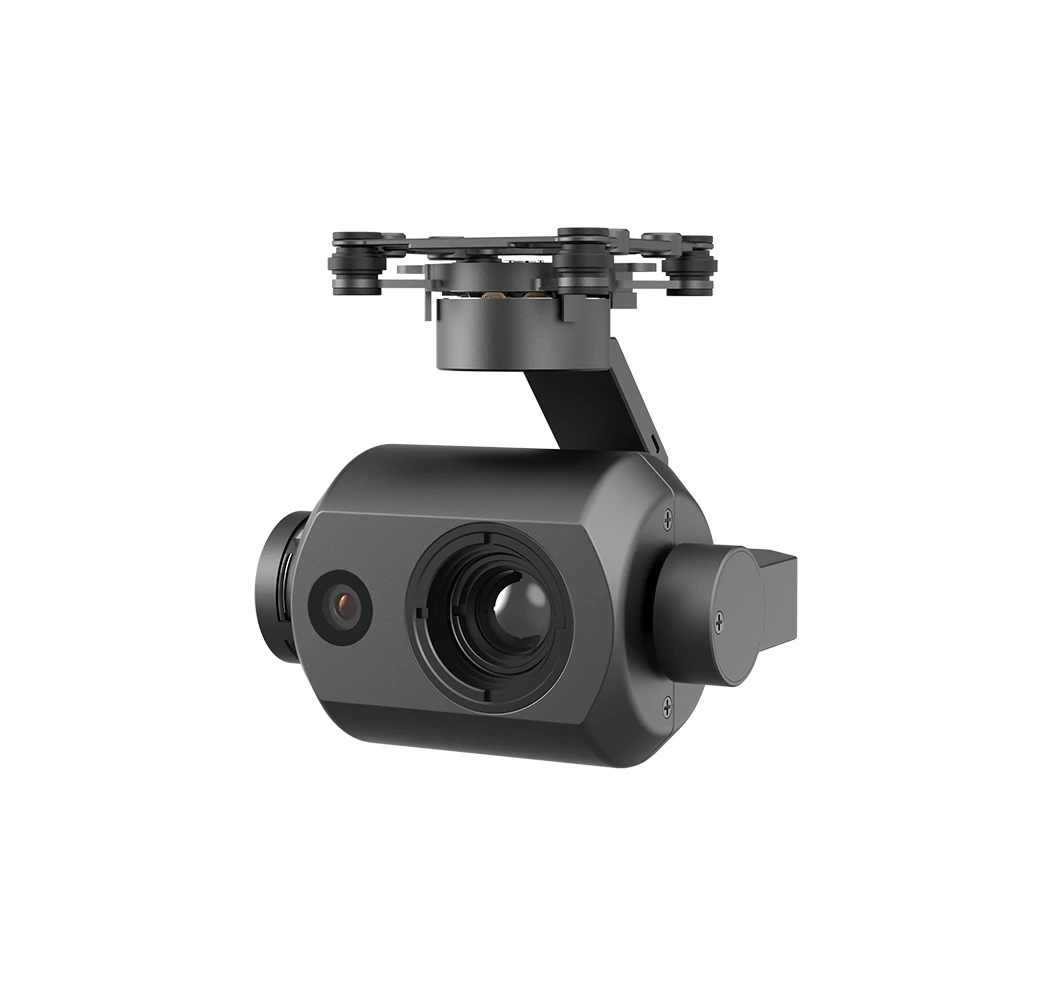
All three rows carry the same pixel count, yet angular resolution per pixel tightens from 0.0755° to 0.0273°, down to a third of where it started. Night recognition range climbs from 120 m to 300 m, the same 2.5x. The pixel count never cast a vote in this; the focal length did all of it.
Total pixels are like the size of a fishing net; angular resolution per pixel is like the size of the mesh. Whether the fish stays in depends on the mesh. How much water one cast can cover depends on the whole net. Answering "what size fish can this catch" with "how big is the net" asks the wrong question from the start.
The Rated Recognition Range Can Be Back-Calculated: The Line Is "12 Pixels per Person"
The recognition ranges printed on factory spec sheets look like figures measured in the field. Most of them are calculated. The criterion in general use is the Johnson criterion: for a target to be recognized in the picture — person or vehicle, and what they are carrying — it needs to occupy something on the order of a dozen pixels; for detection alone, "there is something out there", two or three pixels will do. Recognition and detection differ by more than ten times on the same parameter table, and that line is the reason.
Put that line into the formula and recognition range comes out at roughly target height divided by "12 times the angular resolution per pixel in radians". Run it for an adult 1.7 m tall:
In the 9.1mm group, 0.0755° per pixel converts to 0.001318 radians, and 1.7 divided by 12 times 0.001318 gives 107 m; the data sheet says >120 m. In the 18mm group, 0.0381° converts to 0.000665 radians, giving 213 m against a rated >220 m. In the 25mm group, 0.0273° converts to 0.000476 radians, giving 298 m against a rated >300 m.
All three land close to their rated values, the error coming from the target height assumption and the test conditions. This is useful at two levels. First, you can take any gimbal's data sheet and back-calculate where its rated range came from; if the figure will not come out, or comes out wildly off, the right move is to ask what conditions that number was written under. Second, you can run your own mission backwards: when a customer says "we need to recognize a person at 250 m at night", putting that into the formula tells you which focal length group to look for, without guessing between model numbers. The boundaries between detection, recognition, tracking and geolocation are laid out side by side in our gimbal target geolocation guide.
The limit of this step should be stated as well: what the formula produces is a theoretical ceiling, and the rated value usually sits below it. The PUTD095 uses 384×288 with a 7mm lens, 0.0646° per pixel, and the same formula gives 126 m, while the data sheet only claims >90 m. The drop comes from the test conditions being set at the stricter end. The formula is good for benchmarking and ranking; it does not replace the data sheet.
Going from 384 to 640 Pixels May Not Change How Far You See
The PUDD075GT family carries three thermal grades: GT1 is 256×192 with a 7mm lens, GT2 is 384×288 with 9.1mm, and GT3 is 640×512 still on 9.1mm. Pixels climb all the way up while the focal length stays put for two of the three grades, which is exactly when you should be looking at how the field of view moves.
The GT2 field of view is 29.0°×21.7° and the GT3 is 48.3°×38.6°. Divide each one: 29.0 divided by 384 gives 0.0755 degrees, and 48.3 divided by 640 also gives 0.0755 degrees. The two numbers are identical.
The extra 67% of pixels on the GT3 does not make each target any larger in the frame; it widens the frame by 67%. One mission now covers that much more ground — and the detail landing on each pixel is exactly what the GT2 delivers. Money spent moving from 384 to 640 at the same focal length buys coverage, and the same seeing distance.
So when does paying for pixels actually pay. One case is a mission that needs both a wide field and fine detail — sweeping a large yard while still making out a person in the corner of it — where high resolution is the only answer. The other is digital zoom: cropping a patch of the frame to look closer, and a low pixel count turns the crop to mush. If the mission is simply "recognize a person far away in a fixed direction", the return on a longer focal length lens beats the return on more pixels by a wide margin.
To judge whether a thermal channel resolves finely, there is only one number to count on the parameter table: angular resolution per pixel. Divide the field of view by the pixel count and you are done in ten seconds — more useful than reading ten pages of specifications.
The Cost of Long Focal Length: A 17.5° Frame Is Like Looking at the Sea Through a Straw
The 25mm lens pulls night recognition out to 300 m, and the price is a field of view down to 17.5°×14.0°. Anyone who has flown a rotation knows how narrow that is: whether the target is in frame at all comes down to luck, and once the gimbal sweeps past the moment, you fly another circle. On a search mission those minutes turn into one circle after another, fuel and time burned on the search itself.
The 9.1mm short focal reverses the problem: the 48.3°×38.6° field finds targets easily, but past 120 m a person smears into a blob. Put the two extremes together and the answer lands on "do not pick just one".
The mature approach lets wide and long share the work: the wide channel finds the target, the long channel identifies it, both feeds returning at once so the pilot searches and confirms on a single screen. This is how our tri-sensor gimbals are built — the PUTT155 pairs a wide visible channel with 18mm infrared, and the PUTT170 pushes the infrared to 25mm, each finding its own balance between "finding it" and "seeing it clearly". How the two light paths work together and how zoom divides from fixed focus is covered in our thermal plus zoom dual-sensor guide and zoom versus fixed-focus comparison, and will not be repeated here.
One more line on the ledger: a long focal lens group is heavier and longer, and the gimbal's overall weight and power draw climb with it, which a small aircraft's payload budget may not absorb. Before choosing a focal length, run the platform's weight and power numbers first; the method is in our micro gimbal SWaP budget guide.
The Fine Print Under the Rated Numbers Matters More Than the Numbers
On the same PUTD070A, day recognition is >350 m and night recognition is >120 m, a gap of nearly three times. What differs is light. Daylight hands you the sun as a free source; at night thermal imaging has only the temperature difference between the target and its background.
Every distance on the parameter table carries a string of conditions: visibility no lower than 8 km, relative humidity no higher than 60%, background temperature difference no smaller than 5 K, and the target counted as an adult. Those conditions describe the boundary of the physics. The PUTD095 data sheet also states noise equivalent temperature difference NETD of ≤50mK at 25°C and F#1.0, meaning that when the target-to-background difference falls below 50 millikelvin, the detector can no longer separate target from background noise.
Put the two together and a pile of field mysteries explains itself: why a wall right after rain reads poorly, why thermal imaging clocks off in fog, why a winter morning can work better than a mild afternoon. When the temperature difference is not there, 640×512 and 1280×1024 see exactly the same nothing. More pixels do not fix it; that is the physics. Changing the conditions or the time of the mission can. Spot size and incidence angle are the other reason measured range falls so far short of the rated figure, and our gimbal laser rangefinder guide works that one through in detail.
There is another road at night: starlight visible light. The PUTD070B visible channel uses a 1/2.8-inch 2 MP starlight sensor, and with some ambient light present — city glow, moonlight — it carries far more detail than thermal imaging, and suits face and plate judgment that needs that detail. Thermal imaging and starlight visible light are two kinds of night; which one to carry follows from the mission, not from one replacing the other.
A Selection Table You Can Apply to Your Own Mission
Turning the formula back into a selection action, work backwards from "how far away must one person be recognized at night" instead of comparing parameter lists model by model:
| Mission Type | Night Recognition Need | Focal Length Group to Look At | Matching Models |
|---|---|---|---|
| Plant, campus and site night patrols | 100 m class | 9mm short focal, wide | PUTD070A / PUTD070B / PUTD090 |
| Wilderness search and rescue, river and pipeline inspection | 200 m class | 18mm medium long focal | PUTT155 |
| Border, long-range surveillance, critical asset security | 300 m class | 25mm long focal | PUTT170 |
| Beyond 300 m | —— | 640×512 is the ceiling | Sourced outside our catalog, toward 1280×1024 |
The table is derived from the "12 pixels per person" line and is not a promised value. On a real mission you still stack weather, target contrast, how long the aircraft can hold a stable hover, and whether the gimbal stabilization keeps up. On a gimbal whose stabilization is worse than 0.02°, airframe vibration eats half the long focal advantage; every 0.1° of shake becomes more than half a metre of offset at 300 m, and a recognition range rated any higher will not be delivered.
Where We Fall Short, Stated Plainly
We have no 1280×1024 model in the range. The industry is moving thermal imaging from 640×512 toward 1280×1024, and that is the trend rather than our current stock. If a mission genuinely needs stable recognition of people or vehicles beyond 300 m, say so and we will source it through our supply chain instead of forcing a 640×512 to cover it.
One more consistency note: the rated recognition ranges quoted for the PUDD075GT family and for the dual-sensor family follow different conventions, and the rated figures differ by a noticeable margin at the same focal length. Treat the written data sheet as the reference for selection, read the parameter table as an upper bound, and leave margin in the proposal. Which lens goes with which unit, and what platform it mounts on, is a question we answer by running your mission conditions through the numbers.
The Short Version
Thermal selection: pixel count decides how much ground the picture covers, focal length decides how far that detail reaches, and angular resolution per pixel is the number worth watching. Night recognition range is divided out of the "12 pixels per person" line, not stacked up from total pixels. Divide the field of view by the pixel count on any data sheet before you buy — that is more reliable than asking ten salespeople.
Tell Us Your Setup
Thermal selection does not happen without real operating conditions. Send the mission over — what you are looking for at night, roughly how far, the ambient temperature difference and lighting, what platform you fly, and how much payload margin is left — and we will stack those factors to tell you which focal length group to specify, whether to go tri-sensor, and whether your platform's stabilization and power can carry it.
System integrators (power, emergency, border projects) → state the target type and operating radius, and we work backwards from the recognition range requirement to the focal length group and sensor combination.
Distributors (unsure whether a configuration fits the customer) → send the customer's operating conditions and we confirm the lens group and platform fit.
Recognition beyond 300 m or a 1280×1024 configuration → sourced outside our catalog; state the accuracy requirement and operating conditions and our supply chain will match the model.
How to reach us: leave a message on the inquiry page marked "thermal selection" and our technical team replies within 24 hours. Selection consultations carry no charge.
FAQ: Frequently Asked Questions
What does 640×512 buy over 384×288, and is it worth the price difference?
It depends on the lens. At the same focal length, high resolution buys a wider field of view and the same seeing distance; with a longer focal lens, a lower pixel count can see further. When the mission needs "wide coverage and clear detail at once", the higher resolution earns the difference.
Why can't my thermal camera see clearly at night?
Nine times out of ten the temperature difference is not there. When the target-to-background difference falls below the noise equivalent temperature difference — units in our range sit in the 50mK class — the target smears into the background. A wet wall right after rain, fog, and a target sitting at background temperature all fall into this class. More pixels will not fix it; changing the conditions or the time of the mission will.
Is a wide or narrow infrared field of view better?
It depends on the phase of the mission. Search wants a wide field to find things fast; confirmation wants a narrow field to see clearly. That is why tri-sensor gimbals split the work between a wide and a long channel instead of compromising on one lens.
When do you actually need 1280×1024?
Two kinds of mission: stable recognition of people or vehicles beyond 300 m, or a mission that needs both a wide field and fine detail. Outside those, a 640×512 paired with the right lens is usually the better buy and lighter with it. We have no 1280×1024 model in the range; that requirement can be sourced outside our catalog.
Can the rated recognition range be written into a contract?
Not advised. Those figures hang on specific conditions — visibility, humidity, temperature difference, target type — and the result moves when the conditions do. A contract should define the verification method and acceptance conditions against the real operating environment rather than copying the rated value.
Can starlight visible light replace thermal imaging?
No. Starlight visible light needs ambient light: the detail is better, but it fails in full darkness. Thermal imaging runs on temperature difference and needs no light, yet it also fails when the temperature difference is not there. Night missions are two kinds of night, and which to carry follows from the mission.
Are tracking and recognition the same thing?
No. Tracking keeps the target from leaving the frame once it is locked; recognition judges what the thing in the frame is. The two place different demands on pixels and frame rate. How AI tracking modules rate their lock-on distance and what affects it is covered in our AI tracking module field guide.
Disclaimer: specifications in this article are taken from the factory data sheets of our products in the current range, and the formal quotation and the data sheet issued for your configuration take precedence. The angular resolution and recognition range figures derived in this article follow from geometry and do not account for atmospheric attenuation, mounting error or flight-controller attitude solution error; they are worked examples, not measured results, and actual recognition range must be confirmed against the specific platform, lens and operating conditions. The Johnson criterion cited is publicly available technical literature, included to explain a general principle only, and constitutes no performance claim for our products.