1. Why Drone Searchlight Specs Matter More Than You Think
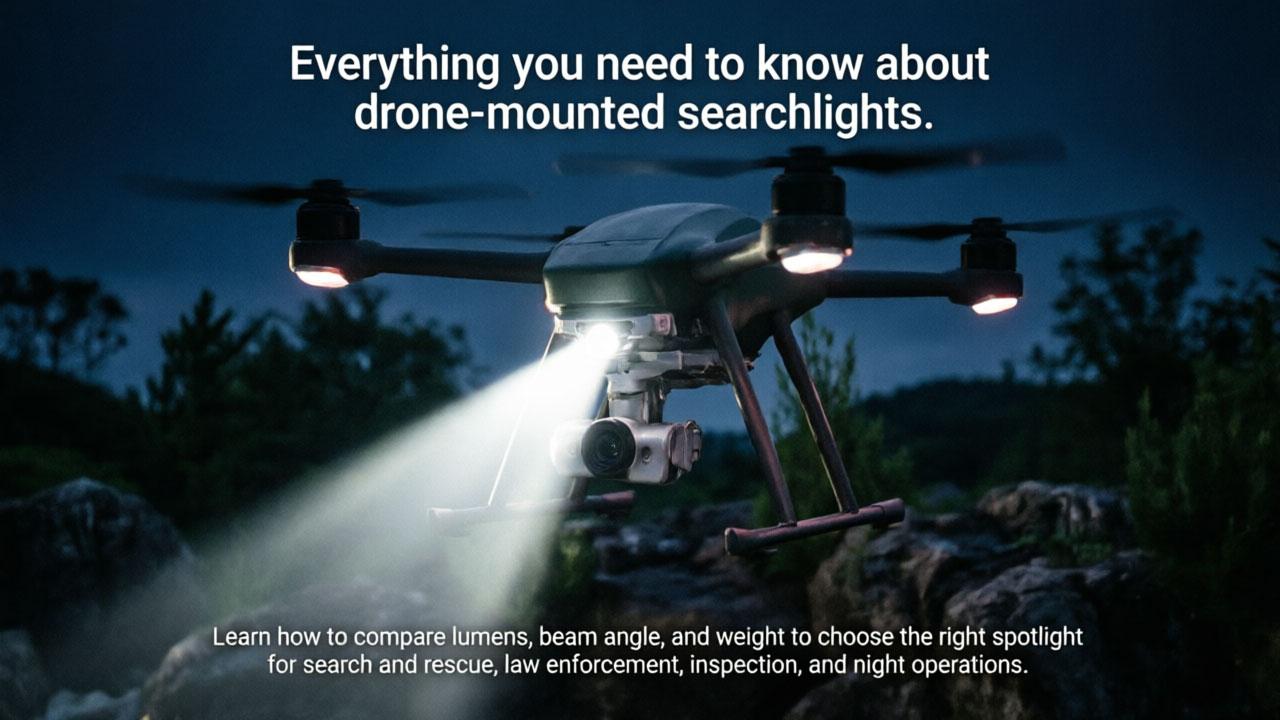
Flying a drone at night without a searchlight is like driving a car with the headlights off — you know you're moving, but you have no idea what's in front of you. A properly chosen drone spotlight doesn't just illuminate the ground; it enables positive target identification, safe landing zone assessment, and effective multi-agency coordination in zero-light conditions.
Three scenarios where the spotlight IS the mission:
- Search and Rescue (SAR): At 2 a.m. in a forest, thermal cameras detect heat signatures. But heat alone cannot confirm identity. A spotlight with sufficient lux at range lets the operator visually verify: is that a person, an animal, or a warm rock?
- Law Enforcement: During a perimeter search, a drone spotlight can illuminate a suspect's position from 200 meters without exposing ground officers. The key spec: beam angle narrow enough to target a specific area without flooding the entire neighborhood.
- Infrastructure Inspection: Power lines, cell towers, and pipelines need close visual inspection at night when operations don't disrupt daytime traffic. A gimbal-stabilized spotlight synced to the camera zoom is essential for reading serial numbers or identifying hairline cracks from 50 meters.
Most operators buy a spotlight based on one number — lumens — and end up with a light that's too heavy for their drone, too wide for their mission, or too dim at operational distance. Let's fix that.
2. The Three Parameters That Actually Determine Performance
When comparing drone spotlights, manufacturers will throw every spec at you. Focus on three:
2.1 Lumens (Total Light Output)
Lumens measure the total amount of visible light emitted. For drone operations, this translates directly into how far you can illuminate a target:
Under 2,000 lm: Compact warning lights and strobes. Good for visibility marking, not for ground illumination. Effective range: 50–100m.
2,000–5,000 lm: Entry-level tactical illumination. Sufficient for close-range inspection and small-area search. Effective range: 100–200m.
5,000–10,000 lm: Professional search and rescue grade. Can illuminate vehicle-sized objects at 300m+. Effective range: 200–500m.
10,000+ lm: Maximum illumination for large-area operations. Provides usable ground illumination at 500m+ with the right beam angle. Effective range: 500m+.
Critical distinction: Lumens measure total output, not distance. A 10,000-lumen floodlight with a 45° beam scatters light everywhere and barely reaches 100m. A 5,000-lumen spotlight with a 4° beam punches through to 500m. Lumens tell you how much light; beam angle tells you where it goes.
2.2 Beam Angle (Coverage vs. Penetration)
Beam angle is the single most overlooked spec — and the one that determines whether your spotlight actually works for your mission:
Narrow Beam (4°–8°): Long-range penetration. Matches high-zoom cameras (15×+). Ideal for point targeting — identifying a specific person, vehicle, or object at 300m+. The trade-off: very small illuminated area at close range.
Medium Beam (10°–15°): General-purpose illumination. Matches 3–8× camera zoom range. Good balance of coverage and intensity for most public safety and inspection tasks.
Wide Beam (20°–30°): Flood/area lighting. Best for situational awareness, landing zone illumination, and wide-angle FPV camera feeds. Covers large ground area but with reduced intensity at distance.
Practical example: At 100 meters altitude, a 4° beam creates a roughly 7-meter circle on the ground. A 15° beam creates a 26-meter circle. Same 100m altitude, same lumen output — but the 4° beam delivers 14× more lux (brightness per square meter) on target. Choose your beam angle based on what you need to see, not what looks impressive in the spec sheet.
2.3 Weight (The Non-Negotiable Constraint)
Every gram of spotlight weight comes directly out of your drone's flight time. Here's what fits on each platform:
Sub-150g: Mavic 3 Enterprise / Thermal. The JZ T30 at 110g is the reference design — enough illumination for close-range work without exceeding the Mavic 3's limited payload budget.
150–400g: Matrice 30 Series. Compact dual-function units like the CZI LP12 (~288g) combine spotlight and speaker in one mount, maximizing the single payload port on the M30.
400–800g: Matrice 350 RTK / M300 RTK. The professional class. Dual gimbal ports allow simultaneous spotlight + camera + speaker. At 530–760g, these units deliver maximum illumination.
800g+: Heavy-lift platforms only (Matrice 400, custom industrial drones). Maximum output, maximum coverage, maximum flight time penalty.
3. Matching Spotlights to Mission Profiles
3.1 Search & Rescue — Wide Area, Long Duration
Requirements: 5,000+ lumens, 10°–15° beam, gimbal-stabilized, strobe mode for signaling.
SAR at night is a race against time. A wide-area flood at 15° lets you scan large sections of forest or water quickly. When you spot a heat signature on thermal, narrow the beam or lower altitude to increase lux for positive identification. The strobe mode serves double duty: signal the victim's location to ground teams while keeping the drone visible to other aircraft.
3.2 Law Enforcement — Targeted, Covert, Multi-Function
Requirements: Medium lumens, narrow-to-medium beam, RGB strobe capability, lightweight for rapid deployment.
Police operations demand flexibility. A spotlight that can switch from wide-area search to focused beam lets the operator illuminate a suspect vehicle without lighting up the entire block. RGB strobe adds a non-verbal communication layer: red/blue flashing from above establishes presence and can de-escalate situations before ground units arrive. The 1,000-meter strobe visibility means even when the main beam isn't on, the drone remains a visible deterrent.
3.3 Infrastructure Inspection — Precise, Gimbal-Linked
Requirements: 2,000–5,000 lumens, tight beam (4°–8°), gimbal sync with camera zoom.
Inspecting a cell tower at night means reading 2cm bolts from 30 meters. The spotlight must track the camera's field of view precisely — when the operator zooms to 20× on a connector, the light needs to be on exactly that spot. A gimbal-stabilized light with camera FOV tracking eliminates the frustration of illuminating one area while the camera looks at another.
3.4 Emergency / Disaster Response — Rugged, Multi-Color
Requirements: IP54+ weather resistance, multi-color strobe, high reliability.
Post-earthquake or flood operations happen in rain, dust, and debris. The spotlight needs to work after being exposed to water spray (IP54 minimum). Multi-color strobes — red for danger zones, green for safe routes, blue for coordination — enable silent visual communication across a disaster site when radio channels are saturated.
4. Spotlight Technology: LED vs. LEP
2025–2026 has seen a new technology enter the drone spotlight market:
LED (Light Emitting Diode): Proven, reliable, efficient. Most drone spotlights use LED arrays. Advantages: lower cost, instant on/off, wide availability. Best for: general-purpose illumination, flood applications, RGB/multi-color units.
LEP (Laser Excited Phosphor): Newer technology. A blue laser excites a phosphor element to produce bright white light. Advantages: dramatically longer throw distance at lower power, extremely tight beam control. Best for: long-range point targeting, matching high-zoom cameras (30×+). Trade-off: higher cost, narrower beam, less suitable for area flood.
For 90% of drone operations, LED remains the practical choice. LEP is worth the investment only if your primary mission is long-range identification beyond 300 meters.
5. Quick Reference: How to Choose Your Spotlight
Step 1 — Check your drone's payload budget: Weigh your camera, battery, and any other payloads first. What's left (in grams) is your spotlight budget.
Step 2 — Define your primary mission distance: 50–100m = compact LED. 100–300m = mid-power LED, 10°–15° beam. 300m+ = high-power LED or LEP, 4°–8° beam.
Step 3 — Decide: single function or combo: If you need both light and speaker, a combo unit saves weight and occupies one payload port instead of two.
Step 4 — Check the interface: SkyPort V2/V3 for M300/M350, PSDK E-Port for M30/Mavic 3. Adapters exist but add weight.
Step 5 — Add strobe if needed: For night ops, law enforcement, or multi-agency coordination, RGB strobe capability adds a layer of functionality beyond illumination.
6. Summary: Lumens Get the Glory, Beam Angle Does the Work
The spec sheet headline is always lumens. But in the field, beam angle determines whether those lumens actually help you see the target. Weight determines whether your drone can even carry the light. And mission profile determines the balance between all three.
The best drone spotlight isn't the brightest — it's the one that:
- Fits within your drone's payload budget with margin to spare
- Delivers usable lux — not just headline lumens — at your operational distance
- Has the right beam angle for what you're looking at (person? vehicle? landing zone? tower bolt?)
- Integrates with your existing control workflow (DJI Pilot 2, web app, or handheld controller)
A well-chosen spotlight turns night operations from high-risk to routine — and in search and rescue, that difference saves lives.
Need help matching a spotlight to your specific drone and mission? Contact us for a tailored recommendation based on your platform and operational requirements.