Fiber-Optic Guided Drone Selection: 5 Key Dimensions That Determine Performance
Updated: July 12, 2026
Fiber-Optic Guided Drone Selection: 5 Key Dimensions That Determine Performance In a high-stakes tactical operation, a radio-controlled drone suddenly loses its video feed and control link within seconds of entering a building complex known to house powerful jamming equipment. The mission stalls. The team on the ground is blind. This scenario is not hypothetical—it plays out daily in electromagnetic interference (EMI) environments, contested airspace, and covert operations where radio frequency
Fiber-Optic Guided Drone Selection: 5 Key Dimensions That Determine Performance
In a high-stakes tactical operation, a radio-controlled drone suddenly loses its video feed and control link within seconds of entering a building complex known to house powerful jamming equipment. The mission stalls. The team on the ground is blind. This scenario is not hypothetical—it plays out daily in electromagnetic interference (EMI) environments, contested airspace, and covert operations where radio frequency (RF) silence is mandatory.
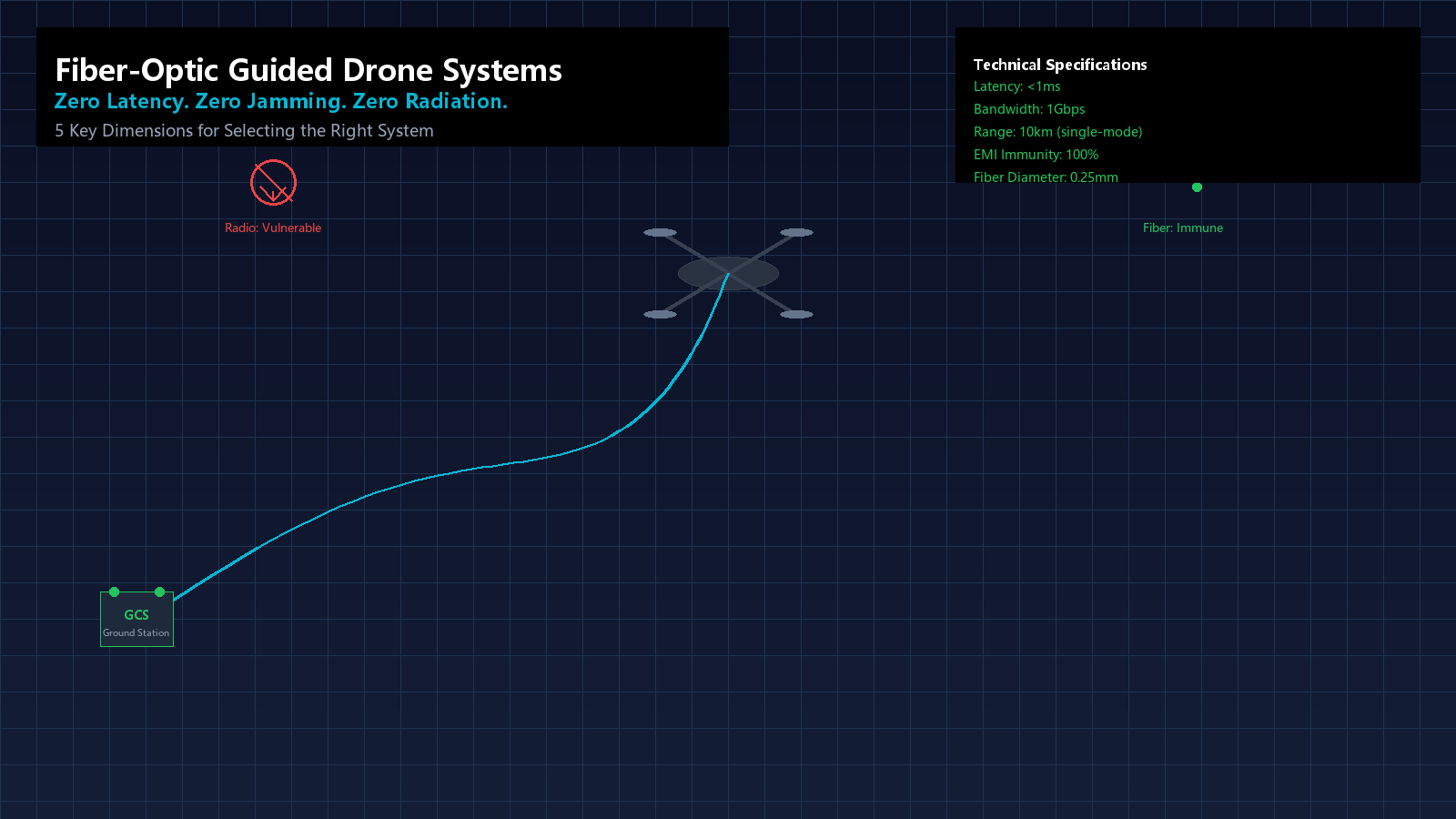
Fiber-optic guided drones solve this problem fundamentally. By replacing the RF link with a physical optical fiber tether, these systems deliver uncompromised video bandwidth, zero-latency control, and immunity to jamming and interception. For procurement managers and enterprise UAV teams evaluating fiber-optic guided drone systems, performance is determined by five critical dimensions.
Why Fiber-Optic Guidance Becomes the Choice for Special Operations
Traditional radio-controlled drones rely on 2.4 GHz or 5.8 GHz RF links that are susceptible to intentional jamming, signal reflection in urban canyons, and EMI from high-voltage power lines or industrial equipment. A fiber-optic guided drone eliminates these vulnerabilities entirely. The physical tether provides a direct, shielded communication channel that cannot be intercepted or disrupted by external RF sources.
This makes fiber-optic guided drones the preferred platform for:
EMI resistant drone operations near power substations, transmission lines, or radar installations
Hybrid guidance drone configurations that combine fiber-optic tether for primary control with backup RF for emergency recovery
VTOL fiber optic drone deployments in confined urban or indoor environments where GPS and RF are unreliable
How Fiber-Optic Technology Breaks Through Three Traditional Limitations
Latency
Radio links introduce 50–200 ms of latency depending on distance and interference. Fiber-optic transmission operates at near light speed through glass, delivering sub-millisecond latency. For real-time FPV piloting and precision payload deployment, this difference is mission-critical.
Bandwidth
Standard drone video links max out at 10–20 Mbps under ideal conditions. Fiber-optic tether supports multi-gigabit throughput, enabling simultaneous 4K video streams, thermal imaging, LiDAR data, and telemetry without compression artifacts or frame drops.
Anti-Jamming
Fiber-optic signals are immune to electromagnetic interference. There is no RF signature to detect, jam, or spoof. For covert operations and fiber optic guided drone missions in contested environments, this is the decisive advantage.
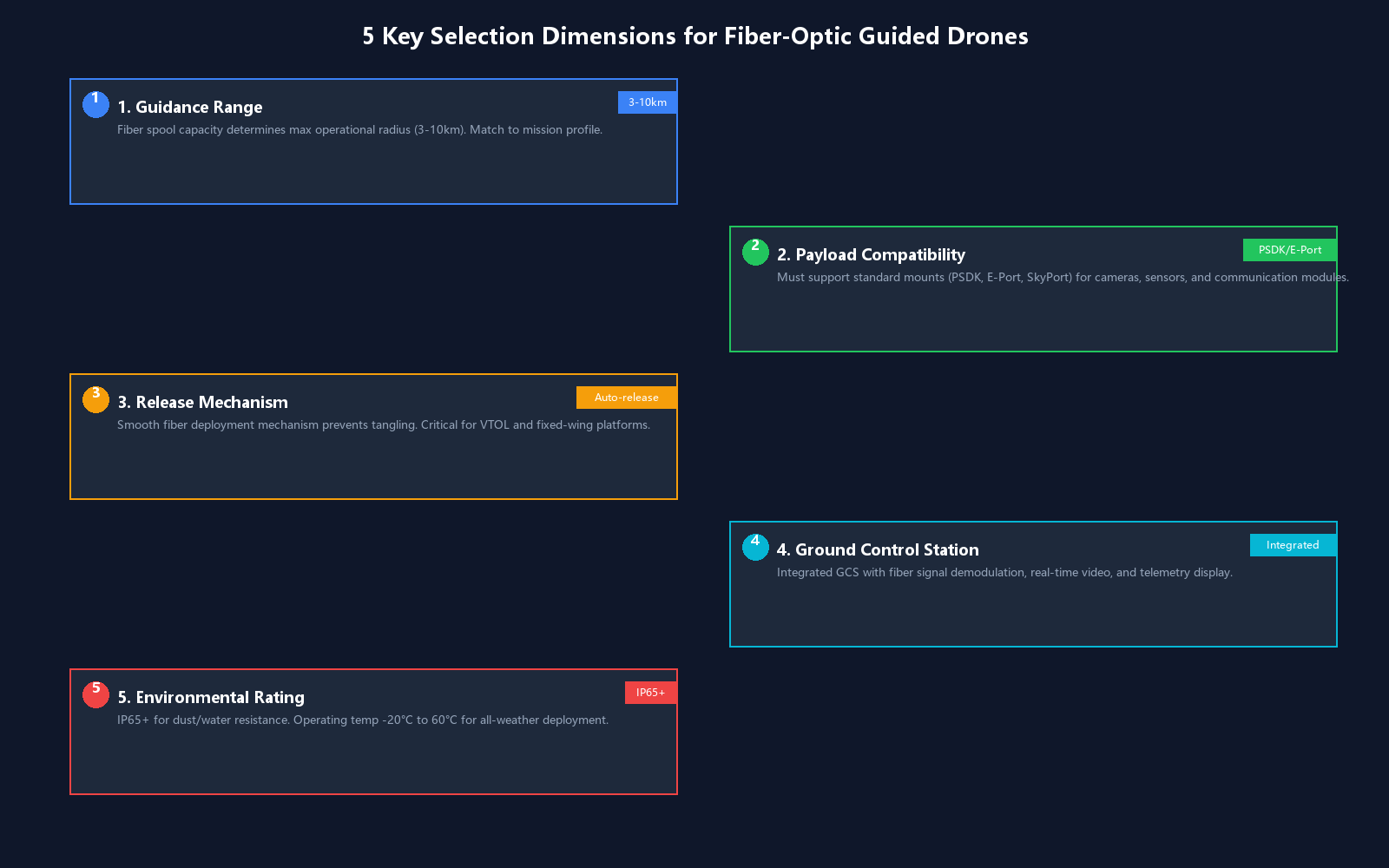
Five Key Selection Dimensions
1. Guidance Range and Tether Management
The operational range of a fiber-optic guided drone is determined by the fiber spool capacity and the drone's power budget. Typical systems offer 1–10 km of tether. Key considerations:
Spool weight vs. flight time: Heavier spools reduce payload capacity. For the DJI Matrice 400 platform, a 1 km spool adds approximately 250 g, while a 5 km spool adds 800 g.
Pay-out mechanism: Passive pay-out (gravity-fed) is simpler but less reliable in high-G maneuvers. Active motorized pay-out ensures consistent tension and prevents tangle.
Breakaway connector: In emergency scenarios, the tether must release cleanly. Our PL10 Hoist Kit (80 g, 10 kg controllable release) demonstrates the mechanical reliability required for tether management systems.
2. Payload Compatibility and Integration
A fiber-optic guided drone is only as capable as the payloads it carries. All payloads must be DJI Matrice-series compatible via PSDK, E-Port, or SkyPort interfaces. For tactical reconnaissance, consider:
Full-Color Night Vision 3-Axis Gimbal YL-W1 (135 g, 0.001 Lux sensitivity, AI ISP algorithm) – ideal for covert night operations
YL-R0601M Uncooled IR Core (27 g, 640x512 resolution, 50 Hz frame rate) – thermal imaging for target detection through smoke or foliage
T90 Searchlight (475 g, 13,400 lm, 3-axis stabilization) – high-intensity illumination for search and rescue
Payload brackets such as the M400 Center Single Gimbal Mount (80 g) and M400 Center Dual Gimbal Mount (165.5 g) allow simultaneous mounting of multiple payloads while maintaining center-of-gravity stability.
3. Release Mechanism and Emergency Protocols
In fiber-optic guided drone operations, the tether itself can become a liability if entangled. Critical features include:
Emergency tether release: The PL10 Hoist Kit supports APP or remote-controlled hook release for emergency disentanglement
Redundant control: Hybrid systems that retain a low-power RF backup for emergency return-to-home
Passive fail-safe: Mechanical release mechanisms that operate without power
4. Ground Control Station (GCS) Integration
The ground control station for a fiber-optic guided drone must handle:
Fiber optic interface: SFP+ transceiver modules for video and data reception
Spool management: Motorized spool with tension feedback and pay-out rate control
Multi-payload control: Compatible with DJI Pilot 2 for controlling payloads like the DS16 Warning Screen (52-inch, 1550 g, 120° viewing angle) or the T40S Speaker-Searchlight Combo (175 g, 114 dB, 4G handheld mic)
5. Environmental and Durability Ratings
Fiber-optic guided drones operate in harsh environments. Minimum specifications:
IP44 or higher for payloads (e.g., LD5 Laser Projector at IP44, T90 Searchlight at IP44)
Operating temperature: -10°C to 50°C (all our payloads meet this range)
Storage temperature: -20°C to 60°C
Fiber jacket: Kevlar-reinforced for abrasion resistance and tensile strength
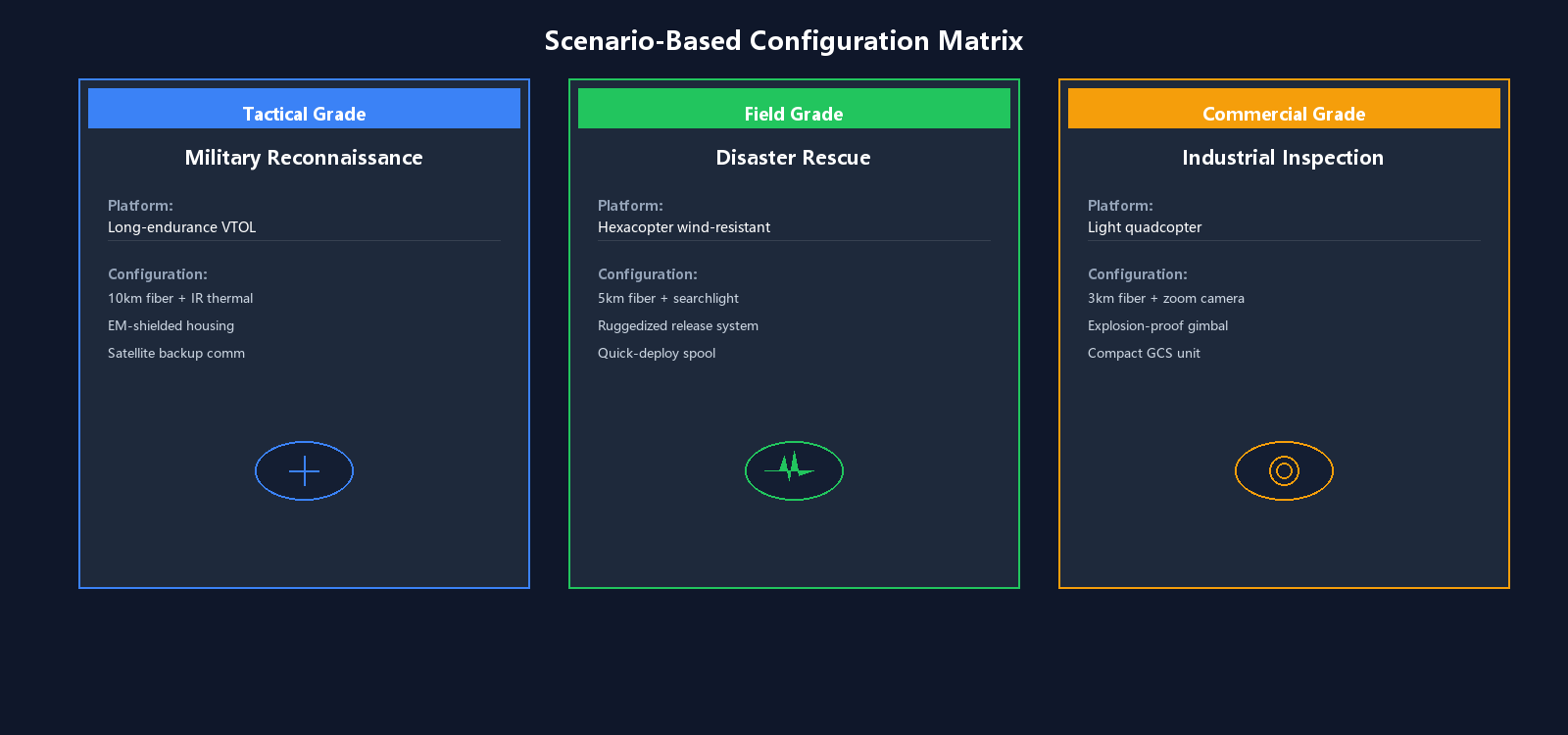
Scenario-Based Configuration Matrix
Military Reconnaissance / Tactical Reconnaissance Drone
Support equipment: M30 PSDK Quick-Release Bracket (14 g), 1 km fiber spool
Key advantage: Inspection near live power lines without RF interference, real-time HD video
Supporting Equipment: Ground Control, Spool Management, Power Supply
A complete fiber-optic guided drone system requires more than the airborne platform. Essential ground equipment includes:
Spool management unit: Motorized spool with tension control, pay-out rate up to 10 m/s, and emergency brake
Fiber optic media converter: SFP+ to Ethernet or SDI conversion for GCS integration
Power supply: 24V DC or battery-powered for field deployment
Backup RF module: For hybrid guidance drone configurations, a low-power 900 MHz or 2.4 GHz link for emergency return
Our FC30 Center Triple-Load Bracket (350 g, 120 kg max load) demonstrates the mounting flexibility required for complex payload configurations, supporting up to three droppers or sensor packages simultaneously.
Operator Training and Maintenance
Transitioning from radio-controlled to fiber-optic guided drone operations requires specific training:
Tether management: Operators must learn to manage spool pay-out rates, avoid tether entanglement, and execute emergency release procedures
Flight dynamics: The tether adds drag and weight, affecting flight characteristics. Training on simulators with tether physics is recommended
Payload integration: Understanding PSDK/E-Port/SkyPort interfaces for quick payload swaps
Maintenance: Fiber optic connectors require cleaning and inspection after each mission. Spool bearings and pay-out mechanisms need periodic lubrication
FAQ
Q1: What is the maximum range of a fiber-optic guided drone?
Practical ranges are 1–10 km depending on fiber spool capacity and drone payload. For DJI Matrice 400-class platforms, 5 km spools are standard. Longer ranges require heavier spools that reduce payload capacity.
Q2: Can fiber-optic guided drones operate in rain or snow?
Yes, provided all payloads meet minimum IP44 protection. Our T40S Speaker-Searchlight Combo (IP54) and T90 Searchlight (IP44) are rated for wet conditions. The fiber jacket must be abrasion-resistant and sealed against moisture ingress.
Q3: How does the tether affect flight time?
The tether adds weight and drag. A 5 km spool adds approximately 800 g, reducing flight time by 20–30% compared to untethered operation. However, the tether eliminates the need for high-power RF transmission, partially offsetting the weight penalty.
Q4: What happens if the tether breaks?
Hybrid guidance drone systems include a backup RF link for emergency return-to-home. Pure fiber-optic systems require the drone to have sufficient battery to return to the tether break point for manual recovery. Emergency release mechanisms (like the PL10 Hoist Kit) allow the drone to detach from the tether entirely.
Conclusion
Fiber-optic guided drones represent the definitive solution for missions where RF reliability is not optional. By evaluating systems across the five dimensions of guidance range, payload compatibility, release mechanisms, GCS integration, and environmental durability, procurement managers can select a configuration that meets operational requirements without compromise.
As a manufacturer of DJI-compatible payloads and brackets, we provide the building blocks for custom fiber-optic guided drone systems. From the YL-W1 full-color night vision gimbal (135 g, 0.001 Lux) to the PL10 Hoist Kit (80 g, 10 kg release), every component is designed for seamless integration with DJI Matrice-series platforms via PSDK, E-Port, or SkyPort interfaces.
Contact our engineering team to discuss your specific mission requirements and receive a configuration proposal tailored to your operational environment.