When dealers talk about transport drones, the question they ask most is: "Who is a 100 kg-class cargo drone actually for?" To be honest, that question is backwards. The question should not be "who is it for" but "what kind of route is it for." A heavy-lift cargo drone that can carry 100 kg does not earn its keep on a parcel shelf. It earns its keep on the short-haul heavy transfers where trucks cannot reach, bridges cannot span, people should not go, and a single vehicle trip cannot carry the load. This guide walks through the TS100 the way we have used it in the field: real specifications, real use cases, real limits — so you can judge which client's budget it belongs in.
Let us set the positioning in stone first: the TS100 is a civilian transport drone for logistics, emergency response and construction resupply. It has nothing to do with combat use. The parameters below all come from factory specifications — no padding.
What the TS100 Is (Heavy-Lift Cargo Drone)
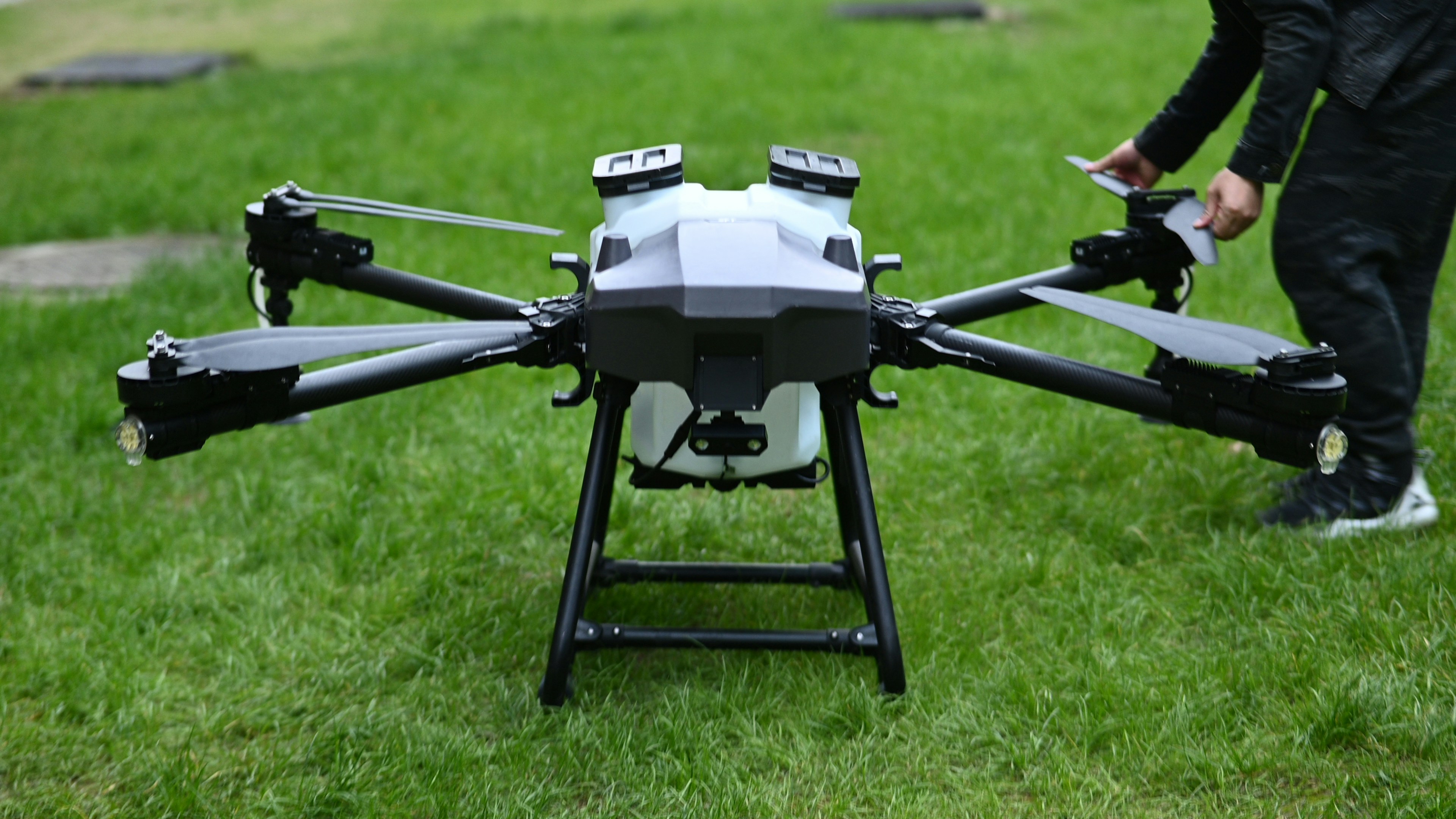
The TS100 cargo drone is Puyu Drone's 100 kg-class quadcopter with four arms and eight motors. "100 kg-class" refers to a payload tier that has taken shape on the international market: roughly 100 kg of useful payload on a machine whose take-off weight is in the hundreds of kilograms, designed for industrial logistics and emergency scenarios. In recent years overseas platforms such as the DJI FlyCart 100 and FlyingBasket FB3 have entered this tier one after another, which tells you the 100 kg tier is a market-validated category — not some oddball a single factory dreamed up.
The TS100 follows the "big quad" technical route: four arms, eight motors, one-piece molded frame, and clip-lock folding arms. Its positioning is straightforward — heavy payload, easy transport, fast turnaround: the whole airframe folds down to fit in a vehicle, and the battery bay is removable for rapid swaps, so crews can swap batteries on site and keep flying sorties back to back.
How It Gets 100 kg Off the Ground (How It Works)
Getting 100 kg into the air reliably comes down to four kinds of redundancy:
- Propulsion redundancy: with eight motors, if one motor fails the remaining power can still hold the attitude — the load is not simply dropped.
- Power redundancy: two 18S 65000mAh battery packs supply the system, so if one pack acts up the other still covers it.
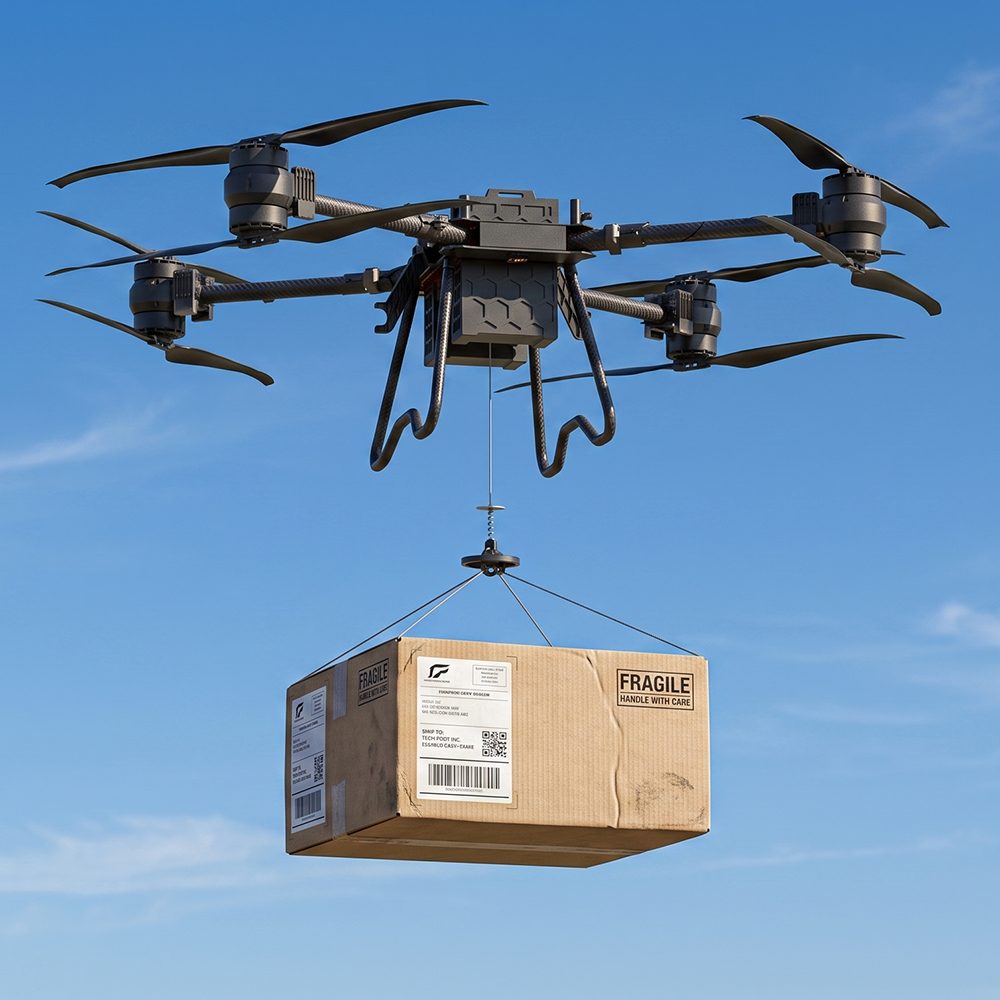
- Payload redundancy: the airframe has reserved hardpoints, so cargo boxes, hooks and lightweight release devices can all be configured per mission.
- Link redundancy: a 30 km video/control link plus remote route planning lets the pilot pre-plan lines at the ground station and watch status in real time.
One sentence sums up its temperament: a heavy-lift platform is about "holding the load, stowing the load, swapping fast" — not about flying fancy.
Real Specifications at a Glance
| Parameter | Value | Parameter | Value |
|---|---|---|---|
| Airframe | Quad, 8 motors | Max useful payload | 100 kg |
| Max take-off weight | 168 kg | Empty weight | 41.8 kg |
| Wheelbase | 2176 mm | Unfolded size | 2930 × 2917 × 663 mm |
| Folded size | 896 × 849 × 792 mm | Max flight speed | 12 m/s |
| Wind resistance | Beaufort 6 | Max ceiling | 1500 m |
| Battery | 18S 65000mAh × 2 (removable battery bay) | Video/control range | 30 km |
| Endurance | ~50 min empty; ~10 min at 100 kg payload | Camera | 1080P stabilized gimbal |
The 30 km figure is the video and control signal range — not a delivery radius for "fly 30 km out, drop the load and come back." More on this below.
Where It Is Used (Four Civilian Transport Use Cases)
The typical scenarios recorded for the TS100 in our catalog are all civilian transport:
- Emergency supply delivery: when floods or landslides cut the roads, life-saving supplies (water, food, medical kits) can be flown straight in with the TS100 instead of waiting for the road to reopen. Emergency supply delivery is the job it wins most often.
- Island and remote resupply: for offshore islands, mountain areas and mining camps, one boat trip or truck run is expensive and slow; a hundred-kilogram airlift can turn "wait three days" into "wait one hour."
- Construction material lifting: at bridge towers, canyon worksites and high-rise work faces, where lifting materials and tools by hand is impractical, drone lifting can deliver equipment into place and cut manual-work risk.
- Industrial site transfer: moving heavy parts, spares and fuel across zones inside a plant — ground logistics detour, while the air route is the shortest straight line.
What these scenarios share: short distance, very heavy per trip, hard to reach by ground — which is exactly the home ground of a 100 kg-class cargo drone.
Payload × Endurance × Distance: Three Iron Rules
When selling heavy-lift aircraft, the worst thing you can do is set the client's expectations wrong. Remember these three iron rules:
1. Full-load endurance and empty endurance are two different things: the TS100 flies about 50 minutes empty, but only about 10 minutes loaded to 100 kg. When you do the math for a client, always use the full-load case — never fudge with empty numbers.
2. 30 km of range ≠ 30 km of delivery: the 30 km is how far the remote-control and video signal reaches, not a cargo radius. Heavy payloads over short hauls is its proper use; for long-haul transport pick a different platform or stage relays.
3. "Holding the load" beats "flying far": choose first by how heavy each trip is and how hard the site is, then by how far it flies. In the payload/endurance/distance triangle, it puts its chips on payload and wind resistance (Beaufort 6).
Why the Market Is Growing (Third-Party Data)
This is not us pushing products off the top of our heads. A few third-party figures for your stocking decisions:
- The global heavy-lift delivery drone market was about US$810 million in 2024 and is projected to reach US$3.17 billion by 2034, a compound annual growth rate of 14.6% (market.us).
- Within the 2025 heavy-lift drone market, logistics and delivery applications account for about 50% and multirotor configurations for about 60% of the share (PW Consulting) — which shows "multirotor + logistics" is exactly the mainstream direction of this category.
- Most relevant to your home turf: the Middle East & Africa drone logistics and transport market was about US$1.186 billion in 2025 and is projected to reach US$3.015 billion by 2034 (360 Research Reports); the drone parcel delivery segment in MEA is growing at a CAGR of 19.25%, led by Saudi Arabia, the UAE and South Africa (industryresearch.biz).
- Category maturity signal: 100 kg-tier platforms such as the DJI FlyCart 100 arrived in force in late 2025, and searches for "heavy lift cargo drone" surged at the same time (Accio / Google Trends) — when the big players enter, dealers who join now are right on time.
In one sentence: emergency, construction and remote-resupply demand across the Middle East and Africa is ramping up, and the 100 kg-class cargo drone is the heavy-lift category most likely to open orders in the region over the next two years.
Common Misconceptions (Straight Talk)
- The 30 km video link means "the signal reaches 30 km," not "it can transport 30 km." With ~10 minutes of endurance at full load, the real operating radius has to be calculated carefully for round trips, payload and reserve power.
- It is an industrial heavy-lift platform — not a parcel courier drone, and definitely not a passenger aircraft. Do not talk about it with consumer-drone expectations.
- Endurance and wind resistance are ideal values; strong wind, high heat and full loads all discount them. Leave margin in quotes and proposals.
- Rules for heavy-lift drones differ from country to country. Verify local airspace and operating requirements before starting a project (this article is not certification advice).
Customization and "Out-of-Catalog Sourcing"
The TS100 airframe leaves room for the mission: cargo box dimensions, lifting methods and release mounts can all be adjusted per project. Auxiliary payloads such as loudspeakers and searchlights can also be supported, but these belong to the DJI-ecosystem adapter accessory category and are honestly labeled as "compatible with DJI enterprise aircraft" — no overclaiming. If your client's project needs a platform we do not list, use our "out-of-catalog sourcing" route: send us the mission brief and our domestic supply chain will match the machine — this is how Puyu Drone works with many dealers over the long run.
Related reading: Drone Delivery Guide for Remote Areas, FPV Recon Drone Size Selection Guide.
FAQ
Q: Which clients are the right fit for the TS100?
A: Those with "short-haul heavy cargo on ground that is hard to reach" needs — emergency agencies, island/mining/remote camps, construction contractors, and logistics companies doing feeder transfers. That is the sweet spot.
Q: How far can it fly at full load?
A: At a 100 kg payload, endurance is about 10 minutes; the operating radius should be calculated for round trips and reserve power. The 30 km is the video/control range, not the delivery distance.
Q: How do crews swap batteries to keep flying on site?
A: The battery bay is designed for removal; with two spare packs crews can swap quickly on site and keep flying sorties. The exact configuration can be customized per project.
Q: Can it carry loudspeakers, searchlights or similar payloads?
A: The airframe has reserved hardpoints for lightweight payloads. Loudspeakers and searchlights belong to the DJI-ecosystem adapter accessory category and should be configured as needed and honestly labeled for the compatible aircraft.
Q: Can the mounts and cargo box be customized?
A: Yes. Box dimensions, lifting and release mounts can be customized per mission; platforms not in our catalog can be sourced through the "out-of-catalog" route.
Q: Is the TS100 for civilian or military use?
A: It is a civilian transport platform positioned for logistics delivery, emergency supply drops and construction resupply — not for combat use.
Closing
Selling a heavy-lift cargo drone is not selling an aircraft. It is selling the ability to get heavy cargo to the end of the road. Send us your client's mission scenario (what is carried, how heavy, how hard the ground is) and we will help you judge whether the TS100 fits and how the payload should be configured. If the catalog does not have it, we source it out of catalog. To submit a requirement, use the inquiry page.